Charles-Valentin Alkan (1813-1888)
1. Benedictus, Op. 54 8:53
2-7. 12 Études D'Orgue Ou De Piano À Pedales Pour Les Pieds Seulement, Nos. 1–6. (18:09)
8-19. 11 Grands Préludes Et 1 Transcription Du Messie De Hændel, Op. 66 (49:51)
Credits :
Organ [Organ Of Blackburn Cathedral] – Kevin Bowyer.jpg)
terça-feira, 6 de maio de 2025
CHARLES-VALENTIN ALKAN : Organ Works 1 (Kevin Bowyer) (2007) APE (image+.cue), lossless
CHARLES-VALENTIN ALKAN : Organ Works 2 (Kevin Bowyer) (2007) APE (image+.cue), lossless
CHARLES-VALENTIN ALKAN : Symphonie Op. 39 · Overture · Two Études (Bernard Ringeissen) (1990) FLAC (image+.cue), lossless
The monumental Symphonie, orchestral in conception, yet idiomatically
written for the piano, is in four movements. True to the promise of the
title of Opus 39, each is in a different key. The massive first movement
is in C minor and is followed by an F minor Funeral March, with a
gentle lightening of mood in an F major Trio section of particularly
unexpected charm, before the slow tread of the march is resumed. The
third movement Minuet moves to the darker key of B flat minor and is
more of a Scherzo in mood, with touches of Ländler, contrasted with a
lyrical central G flat major Trio, to be recalled briefly as the
movement comes to an end. The finale, in E flat minor, described by the
American pianist Raymond Lewenthal as a ride in Hell, is impelled
relentlessly forward, its thematic material providing scope for
contrapuntal exploration. This dazzling and demanding movement provides a
conclusion of sufficient weight and brilliance to balance what has gone
before, in a work of subtle cyclic unity.
The eleventh study, an
Ouverture in the key of B minor, opens with a brief prelude, followed
by sombre dotted rhythms, a fleeting reminder of the musical language
Schumann found fitting for the majestic Cathedral of Cologne, melting
into a much gentler mood, a simple theme, simply varied. An Allegro
follows, based on three contrasted themes, the last in a darker mood,
the material from which what follows is constructed. The Ouverture ends
in B major with a final section that opens with a figure associated with
the hunt and proceeds to a final affirmative reference to the opening
of the Allegro.
Opus 39 opens with an A minor study under the
title Comme le vent (Like the Wind), a tour de force for any performer,
demanding, as it does, an extreme of speed. Although of relatively short
duration, its structure corresponds to traditional sonata form, with a
contrasting second melody emerging from the swirl of notes. It is
followed by a study En rythme molossique (In Molossian Rhythm), in form a
rondo, in the key of D minor, moving to D major, and dominated by the
rhythm of the title. There is a return to the minor mode in a brief and
hushed postscript. The two studies offer formidable difficulties to a
performer, but are truer to the title of Opus 39 than much that follows.
naxos
Charles-Valentin Alkan (1813-1888)
1-4. Études From Douze Études Dans Les Tons Mineurs, Op. 39
Symphony, Op. 39 Nos. 4 - 7
5. Ouverture, Op. 39, No. 11
6. Comme Le Vent, Op. 39, No. 1
7. En Rhythme Molossique, Op. 39, No. 2
Credits :
Piano – Bernard Ringeissen
Cover: Notre Dame (1850) (Topographikon)
CHARLES-VALENTIN ALKAN : Sonate De Concert Pour Violoncelle Et Piano Opus. 47 · Grand Duo Concertant Pour Violon Et Piano Opus. 31 (Tedi Papavrami, Christoph Henkel, Huseyin Sermet) (1993) FLAC (image+.cue), lossless
CHARLES-VALENTIN ALKAN : Préludes Op. 31 (Laurent Martin) (1990) FLAC (image+.cue), lossless
The 25 Preludes in all major and minor keys, Opus 31, appeared in 1847,
designed for piano or organ, or, no doubt, for the instrument that Alkan
particularly favoured, the pédalier or pianoforte with pedal-board, for
which Schumann and Gounod, among others, also wrote. The Preludes go
through all 24 keys, returning to a final Prayer in the affirmative
original key of C major. The first set of nine opens meditatively and
proceeds in a sequence of keys that moves alternately up a fourth and
down a third, to F minor in the second and to D-flat major in the third,
Dans le genre ancien, the old style in question being nothing more
ancient than Bach, heard through the ears of Mendelssohn. Jewish
tradition is at the root of the Prière du soir (“Evening Prayer”), the
rejoicing of Psalm 150 and the Cantor’s chant of the Sixth Prelude. The
rhythm of Schubert and harmony of Schumann mark the relatively cheerful
Seventh Prelude, contrasted with La chanson de la folle au bord de la
mer (“The Song of the Mad Woman on the Shore”), where the deep tones of
the sea itself accompany the increasing tension of the song. The group
ends with Placiditas, as tranquil in mood as its title.
The
second group of Preludes opens with a rapid fugal piece in the key of A
minor, leading to a pleasant trifle, Un petit rien. Le temps qui n’est
plus (“Time Past”) brings its own B-flat minor melancholy, leading to
Busoni’s favourite Prelude, inspired by a verse from the Song of Songs,
"I slept, but my heart watched". A rapid B minor Prelude, moving to B
major, is succeeded by Dans le genre gothique (“In the Gothic Style”), a
Prelude of beguilingly un-Gothic simplicity and the gentle melancholy
of the sixteenth of the series. Rêve d’amour (“Dream of Love”), with its
shifting harmonies, and conclusion marked "palpitan", ends the set.
The
third suite, which has the title Enseignement du piano (“Piano
Instruction”) starts with an expressive melody for the right hand, based
on a repeated rhythmic figure. The following Prelude is a morning
prayer, Prière du matin (“Morning Prayer”), followed by a study in
octaves. A gentle interlude in B-flat major gives way to Anniversaire of
apparent ingenuousness, followed by a pair of Preludes, the second of
which is an exercise in velocity, calling for extreme rapidity and
delicacy in the right hand. A C major Prayer ends the work. naxos
Charles-Valentin Alkan (1813-1888)
1-9. 25 Preludes dans touts les tons majeur et mineurs, 1ere Suite, Op. 31
10-17. 25 Preludes dans touts les tons majeur et mineurs, 2me Suite, Op. 31
18-25. 25 Preludes dans touts les tons majeur et mineurs, 3me Suite, Op. 31
Credits :
Piano – Laurent Martin
Cover: Palais de Justice, Paris (1850) (Topographikon)
ALKAN : Piano Works (Ronald Smith) 2CD (2002) Serie Double ƒƒorte | FLAC (image+.cue), lossless
Charles-Valentin Alkan (1813-1888)
CD1 : 1-4. Grande Sonate Op.33 « Les Quatre Âges » (43:26)
5-8. 4 Études ([From] 12 Études Dans Tous Les Tons Mineurs, Op.39)
9. La Chanson De La Folle Au Bord De La Mer, Préludes 4:21
10. Allegro Barbaro, 12 Études Dans Tous Les Tons Majeurs 2:33
CD2 : 1-4. Sonatine, Op.61 (18:16)
5-7. Trois Grande Études Pour Les Deux Mains Séparées (38:41)
8-10. Trois Études De Bravoure, Op.16 (Tre Scherzi) (19:41)
Credits :
Piano – Ronald Smith
Front cover: Adolph von Menzel (1895-1905) – A Weekday in Paris (Kunstmuseum, Düsseldorf/AKG, London)
ALKAN : Grande Sonate 'Les quatre âges' · Sonatine · Le Festin d'Ésope (Marc-André Hamelin) (1995) APE (image+.cue), lossless
In
many respects, the Grande Sonate, Op 33, is one of the pinnacles not
only of Alkan’s output but of the entire Romantic piano repertoire. In
writing a piano sonata, Alkan was reviving and preserving a form which
was not merely undervalued by the French but was even described by
Schumann as being ‘worn out’. In the hands of this extremely discreet
composer, it could almost claim to be a manifesto: composed in the wake
of the 1848 Revolution, and dedicated to his father, it is prefaced by
what constitutes one of the rare official examples of the composer’s
taking an aesthetic stand on an extremely controversial matter:
programme music. His text is not to be overlooked:
Much has
been said and written about the limitations of expression through music.
Without adopting this rule or that, without trying to resolve any of
the vast questions raised by this or that system, I will simply say why I
have given these four pieces such titles and why I have sometimes used
terms which are simply never used by others.
It is not a
question, here, of imitative music; even less so of music seeking its
own justification, seeking to explain its particular effect or its
validity, in a realm beyond the music itself. The first piece is a
scherzo, the second an allegro, the third and fourth an andante and a
largo; but each one corresponds, to my mind, to a given moment in time,
to a specific frame of mind, a particular state of the imagination. Why
should I not portray it? We will always have music in some form and it
can but enhance our ability to express ourselves; the performer, without
relinquishing anything of his individual sentiment, is inspired by the
composer’s own ideas: a name and an object which in the realm of the
intellect form a perfect combination, seem, when taken in a material
sense, to clash with one another. So, however ambitious this information
may seem at first glance, I believe that I might be better understood
and better interpreted by including it here than I would be without it.
Let me also call upon Beethoven in his authority. We know that, towards
the end of his career, this great man was working on a systematic
catalogue of his major works. In it, he aimed to record the plan, memory
or inspiration which gave rise to each one.
The composition and
publication of the Grande Sonate occurred at a crucial moment in the
composer’s life. During the summer of 1848, when the Revolution was not
yet over, Zimmerman, Alkan’s teacher, resigned from his position as
Professor of Piano at the Paris Conservatoire. It would seem natural
enough that Charles-Valentin, his most brilliant and promising student,
should succeed him; but in the troubled climate of the time, and as a
result of some predictable intrigue, it was in fact a second-rate
musician, Antoine Marmontel, who was to gain the post. This was a
particularly bitter pill for Alkan to swallow; he was to fade gradually
further into obscurity and renounce all public and official posts. The
Revolution was also to harm any publicity which might have surrounded
the publication of the Grande Sonate: although it was well heralded in
the music magazines, it would appear that there was not one single
review of the piece, nor one public performance thereafter. The British
pianist Ronald Smith is fully justified in thinking that he brought the
piece to life when he gave it its first public performance in America in
1973!
Alkan was to try his hand at the piano sonata form on four
occasions: the Grande Sonate, Op 33, the Symphony and Concerto for solo
piano, Op 39, and the Sonatine, Op 61, all illustrate the discrepancies
between an inherited Classical form and the trends of Romanticism. The
astonishing complexity of the Grande Sonate was certainly disconcerting
for his contemporaries and sufficiently justified his decision to give
the programme a preface. Let us not forget three of its most markedly
original features: as in the Symphony and Concerto, Op 39, and well
before Mahler or Nielsen, the tonality evolves during the course of the
work without returning to a ‘root tonality’; confining ourselves to the
start of each movement, the keys are respectively D major, D sharp
minor, G major, G sharp minor; if we focus purely on the endings, we
find B major, F sharp major, G major and G sharp minor. The sequence of
tempi was equally likely to be disconcerting for the listener: in place
of the usual quick–slow–quick, Alkan puts four successively slower
movements one after another. Finally, he invokes two of the great
Romantic myths – Faust and Prometheus; the first, immortalized by
Goethe, enjoyed a popularity kept alive by Berlioz, Gounod, Liszt and
Schumann etc, while Prometheus takes us back to antiquity, to an era
which Alkan, being passionate about the Classics, knew well and which he
often referred to in his compositions.
The sonata opens with ‘20
ans’, a frenzied scherzo which frequently reminds one of Chopin’s
Scherzo No 3. Straightaway, the 3/4 time is juxtaposed with accents on
every other beat. The trio portrays the awakening of love, working its
way gradually through various sections, from ‘timidly’ to ‘lovingly’ and
on to ‘with joy’. The coda brings the movement to a whirling
conclusion.
‘30 ans, Quasi-Faust’ is the heart of the sonata. It
opens with the Faust theme which, in four bars, covers the whole
keyboard and states the rhythmic formulae which will permeate the entire
movement. There follows the Devil’s theme, in B major, which is the
inversion of Faust’s theme. Marguerite’s theme, in G sharp minor and
then major, presented at first in a mood of sweet sadness, passes
through numerous climatic changes. The development and the return of the
exposition lead on to four huge arpeggios which spread across every
octave of the keyboard. Now comes a fugue, a horribly complicated
eight-part fugue, which the eye alone can follow in the score; in order
to make it legible, the composer himself establishes the use of
different manuscript styles! The fugue continues until the entrance of
‘Le Seigneur’, and the movement concludes with a clear victory of Good
over Evil, thus inspired by Goethe’s Faust Part 2, unlike the ending of
Berlioz’s opera-oratorio where the composer boldly damns his hero.
‘40
ans, un ménage heureux’ presents a picture of unspoken Romance,
interrupted on two occasions by a charming three-voice digression
entitled ‘les enfants’; this latter section exhibits a use of thirds,
sixths, fifths which is very untypical of Alkan who, unlike Chopin,
usually shows little interest in anything other than octaves and chords.
With the return of the opening section, the theme, treated in canon,
becomes even more animated. The clock striking ten is the signal for
prayer.
‘50 ans, Prométhée enchaîné’ draws us to the abyss. As an epigraph, Alkan cites several verses of the Aesychlus tragedy:
No, you could never bear my suffering! If only destiny would let me
die! To die … would release me from my torments! Would that Jupiter had
not lost his power. I will live whatever he might do … See if I deserve
to suffer such torments! [lines 750–754, 1051, 1091 (the end of the
play)]
After the victory in ‘Quasi-Faust’ and the joy of the
happy household – something which the composer would always be denied –
‘50 ans’ ends with an acknowledgement of failure, in a visionary piece
written without hint of pomposity or excess. Thinking about the
composer’s destiny, the piece is also a premonition.
The
Sonatine, Op 61, was written fourteen years after the Grande Sonate and
forms a striking contrast to it. Concise and concentrated in the
extreme, refined in its style of writing, and of exceptional technical
difficulty, it is a gem of equilibrium and perhaps presents Alkan at his
most accessible. Its first movement, although swept along and
interrupted by violent angry outbursts, maintains a profound coherence,
reinforced by the taut conjoining of its two themes. The Allegramente
which follows, in F major, belongs within the best tradition of Alkan’s
falsely naive works. It is immediately reminiscent of the slow movement
from Maurice Ravel’s Sonatine; Ravel was, moreover, familiar with the
music of this, the composer of Le festin d’Esope. The Scherzo-Minuet, in
D minor, is one of those perpetual motion pieces of which the composer
was so fond; he interrupts its driving rhythm with a trio which eases
the pace of the movement but is unsettled by various rhythmic and
harmonic devices. The finale, Tempo giusto, opens with startling fifths
which conjure up the empty chords of a cello or the toll of bells, in
the style of Mussorgsky in his Pictures at an Exhibition; the sections
which follow vary greatly without ever altering the movement’s deep
cohesion. A dry fortissimo chord brings the four movements to a close.
Le
festin d’Esope completes the cycle of 12 Études dans tous les tons
mineurs, Op 39, to which the Symphony and the huge Concerto for solo
piano belong. The term ‘study’ should be taken to mean the same as it
does to Chopin and a fortiori Clementi or Cramer. Alkan, more so even
than Liszt, expands the scope of this form to the dimension of a
symphonic poem, a rhapsody. Le festin d’Esope consists of a series of
variations on a theme which one might liken to traditional Jewish
melodies. The argument is to be found again in Jean de la Fontaine’s La
vie d’Esope le Phrygien:
One market day, Xantus, who had
decided to treat some of his friends, ordered him to buy the best and
nothing but the best. The Phrygian said to himself, ‘I’m going to teach
you to specify what you want, without leaving it all to the discretion
of a slave’. And so he bought nothing but tongue, which he adapted to
each different sauce; the starter, the main course, the dessert,
everything was tongue. At first the guests praised his choice of dish;
but by the end they were filled with disgust. ‘Did I not order you’,
said Xantus, ‘to buy the best?’ ‘And what could be better than tongue?’
answered Aesop. ‘It is our connection to civil life, the key to the
sciences, the organ of truth and reason. Through it, we build and police
our towns; we learn; we persuade; we rule over assemblies; we fulfil
the greatest of all our duties, namely to praise God.’
The theme
of the tongue, the most important organ and function, is frequently
mentioned in the Bible, Alkan’s favourite book. The variations, apart
from dealing with various technical problems, illustrate without doubt
every possible transformation that a theme could go through; in
addition, one is presented with a succession of little tableaux of the
animal kingdom, Alkan giving us several hints of this such as the
marking abajante.
The Barcarolle which completes this recital is
taken from the third of Alkan’s five Recueils de Chants for piano. These
five books are distinctive in that they are modelled on Mendelssohn’s
first collection of Lieder ohne Worte; they follow the same tone
sequence and conclude with a barcarolle. The Barcarolle from the third
collection is undoubtedly one of Alkan’s most seductive and meaningful
pieces: its melody imprints itself immediately on one’s memory, and the
whole work radiates a melancholic sweetness. (François Luguenot - Hyperion)
Charles-Valentin Alkan (1813-1888)
1-4. Grande Sonate "Les Quatre Âges" Op 33 (38:25)
5-8. Sonatine Op 61 (17:56)
9. Barcarolle Op 65 No 6 3:53
10. Le Festin D'Esope Op 39 No 12 8:45
Credits :
Piano – Marc-André Hamelin
Painting [Cover Painting] – Tiziano Vecellio
CHARLES-VALENTIN ALKAN : Etudes Opp. 12 and 76 · Le preux · Le chemin de fer (Laurent Martin) (1993) FLAC (image+.cue), lossless
The name of Alkan was once joined with Chopin, Liszt, Schumann and
Brahms, as one of the greatest composers for the piano in the age that
followed the death of Beethoven. At the same time he won praise as one
of the most remarkable pianists of his time. Nevertheless much of his
life was spent in eccentric obscurity, withdrawn from society. In recent
years there has been a revival of interest in his music, led at the
beginning of the twentieth century by Busoni and furthered by other
champions. This interest has yet to result in any widespread attention
to Alkan among performers, for whom he often presents very considerable
technical problems.
Alkan was born Charles-Valentin Morhange, the
eldest of the five children of Alkan Morhange, a music-teacher whose
forebears had settled in Paris in the Marais, the Jewish quarter of the
city. He and his brothers chose to use their father's name in preference
to the family name and all were to make their careers in music in one
way or another. Charles-Valentin Alkan made his first concert appearance
as a violinist at the age of seven in 1821. At the Conservatoire he was
a piano pupil of Joseph Zimmermann, future father-in-law of Gounod and
teacher of Bizet and César Franck, and won considerable success as a
child prodigy, exciting even the admiration of Cherubini. He enjoyed the
particular favour of aristocratic patrons, including the Princess de la
Moskova and other members of the Russian circle in Paris, his success
prejudiced to his momentary chagrin by the first appearance of the young
Liszt. With Chopin he felt greater affinity. The two had much in
common, and both were to become respected in Paris as private teachers
to the aristocracy, although Chopin never isolated himself from society,
as Alkan was to, and his musical innovations were to take another form.
In
the 1830s, his studies at the Conservatoire now concluded with great
distinction, Alkan settied ay an apartmeny in the Place d'Orléans. He
continued to busy himself as a composer, chiefly for the piano,
publishing music that Schumann, indulging in his early musical
journalism, found false and unnatural, these the least of his
strictures. Certainly Schumann himself would have found insuperable
technical difficulties in the Trois Grandes Eludes of 1838, one for left
hand, one for right hand, and the third for both hands together. In
March, 1838, after a series of concert appearances in Paris which had
established him as a performer of the first rank, Alkan appeared in a
recital with Chopin, before an enthusiastic audience. This seems to have
been his last public concert for some six years, during which it was
rumoured that a possible affaire with a married woman had led to the
birth of a son, Elie Miriam Delaborde, the future pianist and editor of
some of Alkan's music.
Alkan's concert appearances in 1844 and
1845 were followed by a further long period of silence and withdrawal
from the concert platform. 1848 in particular brought a significant
disappointment. Considered by many, and certainly by himself, as the
clear successor to Zimmermann at the Conservatoire, he was passed over
by the new Director, Auber, who chose to appoint instead Marmontel, a
younger musician for whom Alkan had little respect, as is apparent from
the letters he wrote supporting his own candidature, enlisting George
Sand among others in his cause. He gave a concert in May, 1849, his last
for the next 25 years.
Isolating himself from the general
musical life of Paris, Alkan continued in the following years to teach
and, intermittently, to compose. Protected from unwanted visitors by a
vigilant concierge, he lived a hypochondriac bachelor existence of
obvious eccentricity, continuing his long-standing interest in the
scriptures and translating from the Hebrew Talmud and later from the
Syriac version of the New Testament. In 1873, however, he emerged from
retirement to offer a series of Six Petits Concerts de Musique Classique
at the Salons Erard, with which he had had an enduring association. As
in his programmes of forty years before, or those of Rubinstein's
historical concerts, he offered a remarkable conspectus of keyboard
music, played with a classical precision and a technique only slightly
affected his years. These concert series seem to have continued
intermittently until the time of his death in 1888, while the curious
could hear him every Monday and Thursday at the Salle Erard, where an
instrument was at his disposal.
The manner of Alkan's death has
been a matter of some speculation. Although the narrative has been
romantically embellished, it seems probable that he died as the result
of a domestic accident, when a cupboard or book-case fell on him.
Whether or not he died clutching a copy of the Talmud, retrieved from
the top shelf of the collapsing book-case, is open to doubt. The story
emphasises, at least, Alkan's religious and literary interests, offering
an interesting inverse parallel to the flamboyant career of his
contemporary Liszt, turned Abbé, who had died in lodgings in Bayreuth,
attended by one of his young female pupils, in 1886.
In 1837
Alkan published a series of twelve pieces, Trois études de bravoure or
Improvisations, Op. 12, Trois andantes romantiques, Op. 13, Trois
morceaux dans le genre pathétique, Op. 15 and Trois études de bravoure
(Scherzi), Op.16. These twelve piano pieces were issued in four volumes
under the general title Douze Caprices. The studies that form the first
volume had the earlier title Improvisations dans le style brillant,
aptly descriptive. The first of the three, with its leaping octaves and
sudden modulations, opens the door to a new world, technically and
musically. It is followed by a D flat major Allegretto, initially a
gentle contrast, although it increases in intensity, before the wistful
ending over a sustained pedal-point. The Improvisations end with a B
minor March, transforming what might otherwise have seemed trite
thematic material into something much more imposing.
Le preux,
Op. 17, The Valiant Knight, was published in 1844, and is again a
bravura concert study, offering technical challenges to the performer,
something suggested already in the choice of title, with pianist as
champion. Lechemin de fer, Op. 27, The Railway, was also published in
1844,celebrating in musical terms a railway journey, a relative novelty
of the period and something that was to provide material over the years
for a number of other composers, intrigued by the rhythm of the machine
and the whistle of the engine. Railway journeys of this kind presented
possible dangers, and of these Alkan is well aware, as the train gathers
by speed, before coming to a halt in safety.
The Trois grandes
études, Op. 76, first appeared in 1838, although they were subsequently
given the opus number of a later period. The first of these formidable
studies is an A flat Fantaisie for left hand alone. An introduction is
developed at an increased speed, leading to an extended final section,
based on a sinister theme announced in lower register octaves. The
second study, a D major Introduction, variations et finale for the right
hand alone, makes still greater technical demands. The opening is in
the form of a solemn introduction, with just the suggestion of a well
known Schubert song in its melodic contour. The gentle theme, in A
major, is followed by variations that explore changes of key and
texture. The gentle staccato of the first leads to a contrapuntal F
major second variation, an elaborate third in C major and a fourth of
astonishing virtuosity, the final variation restoring the original key
of A major, before the histrionic D major Finale. Both hands reunite in
the third study in C minor, an extended rondo that presses forward with
the motor impetus of a rapid tocata naxos
Charles-Valentin Alkan (1813-1888)
1-3. 3 etudes de bravoure, Op. 12
4. Le preux (Etude de Concert), Op. 17
5. Le chemin de fer, Op. 27
6-8. 3 grandes etudes, Op. 76
Piano – Laurent Martin
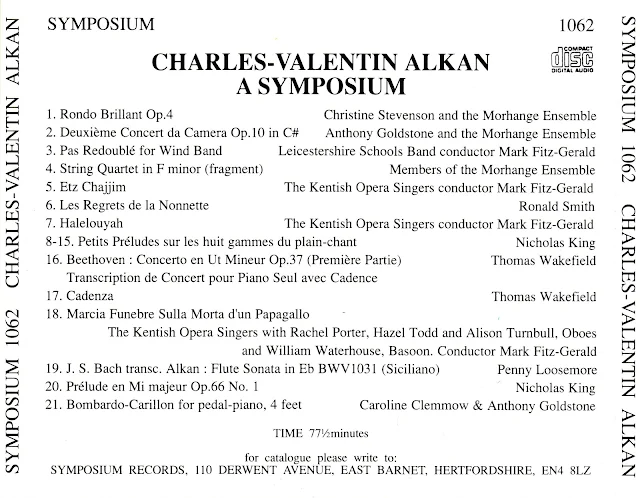
ALKAN : A Symposium (1992) FLAC (image+.cue), lossless
Charles-Valentin Alkan (1813-1888)
1. Rondo Brillant Op.4 12:51
Ensemble – Morhange Ensemble
Piano – Christine Stevenson
2. Deuxième Concert Da Camera Op.10, In C Sharp 7:36
Ensemble – Morhange Ensemble
Piano – Anthony Goldstone
3. Pas Redoublé For Wind Band 2:30
Conductor – Mark Fitz-Gerald
Ensemble – Leicestershire Schools Band
4. String Quartet In F Minor (Fragment) 0:20
Ensemble – Morhange Ensemble
5. Etz Chajjim 2:01
Choir – The Kentish Opera Singers
Conductor – Mark Fitz-Gerald
6. Les Regrets de la Nonnette 3:37
Piano – Ronald Smith
7. Halelouyah 1:33
Choir – The Kentish Opera Singers
Conductor – Mark Fitz-Gerald
8-15. Petits Préludes Sur Les Huit Gammes Du Plain-chant
Organ – Nicholas King
16-17. Beethoven: Concerto En Ut Mineur Op.37 (Première Partie). Transcription de Concert Pour Piano Seul Avec Cadence
Piano – Thomas Wakefield
18. Marcia Funebre Sulla Morte D'un Papagallo 9:12
Bassoon – William Waterhouse
Choir – The Kentish Opera Singers
Conductor – Mark Fitz-Gerald
Oboe – Alison Turnbull, Hazel Todd, Rachel Porter
19. Siciliano, From Flute Sonata In E Flat BWV1031 2:48
Composed By – Johann Sebastian Bach
Piano – Penny Loosemore
Transcription By – Charles-Valentin Alkan
20. Prélude En Mi Majeur Op.66 No.1 1:28
Organ – Nicholas King
21. Bombardo-Carillon For Pedal-Piano, 4 Feet 5:30
Piano [4 Hands] – Caroline Clemmow & Anthony Goldston
segunda-feira, 7 de abril de 2025
ALKAN : Character Pieces & Grotesqueries (Mark Viner) (2023) FLAC (image+.cue), lossless
Charles-Valentin Alkan (1813-1888)
1. Petit Conte 4:02
2. Pour Monsieur Gurkhaus 1:11
3-10. Jean Qui Pleure Et Jean Qui Rit, Due Fughe Da Camera
11-14. Ma Chère Liberté Et Ma Chère Servitude, Deux Petites Pièces, Op.60
15-17. Trois Petites Fantaisies, Op.41
Credits:
Piano [Steinway D] – Mark Viner
Cover: Réunion de 35 têtes d'expression (c.1825), by Louis Léopold Boilly (1761-1845).
Tracks 2 and 4 = first recordings.
CHARLES-VALENTIN ALKAN : Grande Sonate "Les Quatre Ages" · Le Festin d'Esope · Miniatures (Alan Weiss) (1990) FLAC (image+.cue), lossless
Charles-Valentin Alkan (1813-1888)
1. Nocturne No. 1, Op. 22 6:21
2-8. 7 Esquisses, Op. 63
9. Le Festin d'Esope, Op. 39 No. 12 10:12
10. Le Temps Qui N'est Plus, Prelude Op. 31 No. 12 1:32
11. Fa, Op. 38b No. 2, From "2nd Book Of Chants" 3:05
12-16. Grande Sonate, Op. 33, "Les Quatre Ages" (The Four Ages)
16. Toccatina, Op. 75 1:51
Credits:
Piano – Alan Weiss 
CHARLES VALENTIN ALKAN : Chamber Music (Trio Alkan) (1992) FLAC (image+.cue), lossless
The extensive works of Charles Valentin Alkan remain largely
overshadowed in international concert repertoire. Nevertheless Alkan has
had his champions, such as the co-editor of his music, Isidore Philipp
(1863–1958) and Ferruccio Busoni (1866–1924), who regarded him as one of
the five greatest composers of piano music after Beethoven, with
Chopin, Schumann, Liszt and Brahms, and shocked the Berlin public with
the massive Alkan cadenza for the Third Piano Concerto of Beethoven.
Others included the pianists Sergey Rachmaninov (1873–1943), Harold
Bauer (1873–1951) and Egon Petri (1881–1962), who played music by Alkan,
although, regrettably, only occasionally. More recently the pianist
Raymond Lewenthal (1926–1988) created a sensation with his broadcasts of
music by Alkan, while the English pianist Ronald Smith (1922–) remains
an almost monomaniac interpreter of Alkan, as head of the London Alkan
Society and author of the first monograph on the composer, published in
two volumes in 1976, a notable work.
All these efforts, however,
have not so far succeeded in bringing about a radical Alkan renaissance.
This is partly a matter of conservative musical taste. The generation
of virtuosi, piano teachers and gifted amateurs, that, since the middle
of the last century, by the constant study and performance of the music
of Alkan’s contemporaries Chopin, Schumann and Liszt, has established
their works as of lasting cultural value in the eyes of a wider group of
people, has failed to mobilise opinion in favour of Alkan. Although he
was a great virtuoso of the piano, he gave few concerts, particularly
after the year of fate 1848, and consequently had too few pupils of
ability and generally led the life of a recluse in his native city of
Paris, which he virtually never left. He published his works
spasmodically over the years, living the rigorous life of one dedicated
to composition.
The fact that Alkan’s works include no
symphonies, operas, oratorios or songs excluded him from the usual means
in his century of reaching a wider audience. Quite decisive then and
now for the general receplion of Alkan’s music is also the
uncompromising nature of his piano-orientated creativity, shown in his
tendency to short sketches (48 Esquisses, Op. 63), his courage in
tackling macro-structures of unheard of length (Etudes up to thirty
minutes long), harmonic and formal irony, as it were in the manner of
Prokofiev, modernistic motor impetus, as in Le chemin de fer and Allegro
barbaro, perplexing banality, an anticipation of Mahler, underlying
enigmatic irony, a foretaste of Satie, and, last not least, the
sometimes excessive technical demands, greater than the transcendental
challenge of Liszt.
The visionary strength of this Quasi-Faust, a
movement title in his Piano Sonata Op. 33, is also evident in the three
chamber works that Alkan wrote. The first of these, research has
established (Harry Halbreich in An Alkan Reader published by Fayard in
1991), was the Trio for piano, violin and bass in G minor, Op. 30.
Published in 1841, the work, possibly written sometime earlier, starts
Assez largement with a theme of rhythmic energy, which is to be
contrasted with a lyrical second subject. The almost continuous flow of
semi-quavers is concise, with the transitions between the sections of
the movement cleverly hidden. In the middle the thematic material
appears in masterly simultaneous polyphony, partly the climax of the
development, partly recapitulation in the major. In the Scherzo, also in
G minor, there is a rapid and witty exchange between the instruments in
contrast with the dark bass melody of the Trio. The G major Lentement
offers novelty of formal structure. In the classical simplicity of the
four-part string writing abruptly appears a piano cadenza in the manner
of Tchaikovsky (Alkan notes, with a wink, “Le violon et le basse
comptent”). The introduction is repeated in shorter and intenser form
and a short exchange leads to an orchestral tremolo covering the extreme
range of the three instruments. The Finale, in 6/8, demands above all
of the pianist a tremendous perpetuum mobile. Violin and cello, for the
most part in exchange each with the other, propose a motivic and
rhythmic counterpoint, until the appearance of the major coda, in which
the rapid semiquaver movement is taken up by the strings.
Alkan’s
Violin Sonata, the Grand Duo concertant pour piano et violon, in
F-sharp minor, Op. 21, was probably written about 1840. The choice of
key, F-sharp minor and major and related keys, shows that the composer,
who himself also played the violin to some extent, treats the violin as
he did the piano, evident too in the particular lay-out of the violin
part, with its octaves in the highest positions. The first movement of
the sonata offers a contrast between the archaic contour of the opening
and the soaring secondary theme in D major, repeated three times, the
third time “avec exaltation”. The heart of the work lies, without
question, in the slow movement, L’enfer (“Hell”), which offers an
unprecedented vision of the darkest abyss. The extreme closely spaced
dissonances in the deepest range of the piano create a song of mourning.
The brilliant Finale, to be played as fast as possible, fluctuates
between a hectic perpetuum mobile and a fragmented and sometimes
syncopated melodic outline. Alkan dedicated his Violin Sonata, which is
here presented for the first time on compact disc, to the Belgian-born
violinist and composer Chrétien Urhan (1790–1845).
Among the
cello sonatas of the nineteenth century, after the five by Beethoven
written between 1796 and 1815 and Chopin’s Opus 65 of 1845/6 but before
the two by Brahms, written in 1865 and 1886, Alkan’s Cello Sonata in E
major of 1856, Op. 47, occupies an important position, significant in
the development of the form. The arrangement of the string part is as
rigorous as that of the violin sonatas, with four homogeneous and
complementary movements. The cyclical arrangement of keys, E major,
A-flat major, C major and E minor, is striking. The opening Allegro
molto, in classical first movement form, starts in singing style. The
expansive development section has frequent exchanges of scale passages
and a working of motivic detail concentrated often into expressive
fugati. The 6/8 Siciliano of the Allegrettino creates an apparently
simple bass which, through surprising turns of harmony, offers a degree
of uncertainty. In the rich chromaticism there lies a certain sarcasm,
typical of Alkan’s humour. The Jewish believer Alkan prefaces the Adagio
with a quotation from the Old Testament (Micah V. vii) “As dew from the
Lord how the Jewish people endure, awaiting help from God alone”. The
gently sentimental cello theme seems to be inspired by Jewish sacred
music. A clearly modern rhythmic element appears against the piano
cantilena in the plucked notes of the cello. The sonata ends with a
virtuoso Finale alla saltarella. Here the technical demands on both
players stand alone in the musical literature of the nineteenth century.
The Sonata, like the Trio dedicated to James Odier, was first performed
by Auguste Franchomme, the dedicatee and first performer of Chopin’s
Cello Sonata, and Alkan himself in Paris on 27th April 1857. Rainer Klass, naxos
Charles-Valentin Alkan (1813-1888)
1-3. Grand Duo Concertant In F Sharp Minor, Op. 21 (21:39)
4-7. Sonate De Concert In E Major, Op. 47 (32:18)
8-11. Trio In G Minor, Op. 30 (21:10)
Ensemble – Trio Alkan
Cello – Bernhard Schwarz (tracks: 4 to 7, 8 to 11)
Piano – Rainer Klaas
Violin – Kolja Lessing (tracks: 1 to 3, 8 to 11)
CHARLES-VALENTIN ALKAN : Concerto for solo piano (Marc-André Hamelin) (1992) FLAC (image+.cue), lossless
ALKAN : Concerto for solo piano · Troisième recueil de chants (Marc-André Hamelin) (2007) FLAC (image+.cue), lossless
Anyone familiar with the unfailing digits and seemingly inexhaustible
energy of Canadian pianist Marc-André Hamelin would find the very
prospect of his recording Charles-Valentin Alkan's giga-difficult
Concerto for solo piano as a natural match of pianist and piece. This
50-minute mega-monstrosity -- the first movement alone lasts nearly a
half an hour, and runs to more than 70 pages -- has been played only by
pianists intrepid and skilled enough to make the voyage, the short list
including Egon Petri, Alkan acolyte Ronald Smith, and John Ogdon, in one
of his finest recorded outings. With Hamelin, this Hyperion release
Alkan: Concerto for Solo Piano is all the more amazing as this is his
second recorded traversal of the work, having done an earlier version
for the Music & Arts label in 1993. What the 13-year interim has
yielded is a deepening of Hamelin's interpretation, to the point where
the rapid fire runs, leaping octaves, and thundering crescendos that
characterize the work have become second nature and Hamelin is able to
mainly concentrate on making Alkan's concerto sound like the glorious
vision that it is. And that's not to mean the earlier recording was
necessarily "bad," it's just that in the meantime he has achieved total
independence from the technical challenge that Alkan's concerto
represents.
This work is such a trip; it is a combination of
symphony and concerto where all of the orchestral and solo parts are
wound into just the two hands of the pianist. Apart from the first
movement, it has a searing Adagio at its center and the Allegretto
finale is marked alla barabaresca. As Brobdingnagian as the concerto is,
however, Alkan never digresses; it is taut and completely strict in a
formal sense even as it is likely the most expansive work for piano solo
that the nineteenth century has to offer. Hamelin has mastered it, a
feat so awesome that it almost makes one forget that the Hyperion disc
also offers a late and lovely Alkan work as filler, the Third Book of
the Recueil de Chants (1863), never before recorded in its entirety;
Raymond Lewenthal recorded the Barcarolle alone on his groundbreaking
RCA Victor LP Piano Music of Alkan in 1965. In a sense, Hyperion's
Alkan: Concerto for solo piano illustrates how far we've come with Alkan
in nearly five decades' time; from the enterprising, exploratory
readings of Lewenthal in the 1960s to total command of Alkan's
"impossible" pianist language in the 2000s. The one thing Alkan lacks is
a place in the standard literature, and it doesn't appear as though
he's ever going to have that, though if anyone can operate at the
exalted level of advocacy that such a transition of thinking about Alkan
would require, then Marc-André Hamelin is probably the man. Uncle Dave Lewis
Charles-Valentin Alkan (1813-1888)
1-3. Concerto For Solo Piano Op 39 Nos 8-10 (49:35)
4-9. Troisième Recueil De Chants Op 65 (17:57)
Credits :
Piano – Marc-André Hamelin
Front illustration : The Kiss of the Vampire (1916) by Boleslas Biegas (1877-1954) 
quinta-feira, 3 de abril de 2025
ALKAN : Trois Grandes Etudes Op.76 • Trois Etudes De Bravoure (Scherzi) Op.16 (Ronald Smith) (1988) Studio Series | FLAC (image+.cue), lossless
ALKAN : 12 Études Op. 39 (Jack Gibbons) 2CD (1995) APE (image+.cue), lossless
quarta-feira, 2 de abril de 2025
ALKAN : Twelve Studies in all the Major Keys, Op. 35 (Stephanie McCallum) (1994) FLAC (tracks+.cue), lossless
Alkan's monumental Twelve Studies in all the Major keys, opus 35, is a
virtuosic tour-de-force for the pianist. Each study develops an aspect
of technique but each is also pure Alkan - millions of notes and
thunderous drama. McCallum has been praised world-wide for her Alkan
performances, displaying prodigious technique and poised musicianship. web
Charles-Valentin Alkan (1813-1888)
1-6. First Suite
7-12. Second Suite
Credits:
Piano – Stephanie McCallum
Tuner [Piano Tuner] – Ara Vartoukian
segunda-feira, 31 de março de 2025
ALKAN : Symphony for solo piano • Concerto for solo piano (Paul Wee) (2019) SACD | FLAC (image+.cue), lossless
The backstory is a marketer's dream: pianist Paul Wee was a child
prodigy who was playing concertos with major orchestras by 12, traveled
to New York to study, but then abandoned his career to study law and
became a successful London barrister. Except he didn't abandon it. Wee
not only continued to play; he specialized in the music of
Charles-Valentin Alkan, the mid-19th century composer whose works are
still rarely recorded due to their sheer difficulty. In 2015 and 2016,
he gave a pair of recitals at the Alkan Society in London, and a tape
was sent to the BIS label in Sweden. The end result was this release,
perhaps the first one to contain both Alkan's Symphony for Solo Piano
and Concerto for Solo Piano. Both works, part of a larger series of
etudes, are technically hazardous but find room for symphonic effects in
the former and "tutti" and "solo" markings, Alkan's own, in the latter.
Sample the 30-minute first movement of the Concerto for Solo Piano. It
is a sheer storm of notes that taxes the stamina of any pianist who
attempts it, but it contains expressive interludes to which Wee does
justice. There are other recordings of Alkan on the market, notably
those of Marc-André Hamelin, whose style Wee resembles, but there are
none with a story as compelling as Wee's. James Manheim
Charles-Valentin Alkan (1813-1888)
1-4. Symphony For Solo Piano, Nos 4–7 Of Douze Études Dans Tous Les Tons Mineurs, Op.39 (26:16)
5-7. Concerto For Solo Piano, Nos 8–10 Of Douze Études Dans Tous Les Tons Mineurs, Op.39 (51:30)
Credits:
Grand Piano, Liner Notes – Paul Wee
ALKAN : Symphony for solo piano • Trois Morceaux dans le genre pathétique (Marc-André Hamelin) (2001) APE (image+.cue), lossless
Marc-André Hamelin's first solo Alkan recording (CDA66794) met with the
most superlative critical reception imaginable (culminating in Fanfare
magazine's "one of the best releases of anything to have been made, a
classic of the recorded era"). This follow-up proves to be no less
spectacular.
The disc is framed by two of the 'monster' works for
which Alkan is notorious. The four movements of the Symphony for solo
piano are taken from his magnum opus, the 12 Studies in the minor keys
Op 39. This piece has become one of Alkan's best known but never has its
finale (once described as a 'ride in hell') been so spectacularly
thrown off. The Trois Morceaux dans le genre pathétique are the earliest
pieces in which Alkan's true personal style became apparent. These are
three massive studies each with programmatic titles and an atmosphere of
Gothic horror that requires a supreme virtuoso to tackle their
outlandish technical demands. This is their first recording.
The
recital is completed by three pieces of rather religious inspiration.
While their scale and technical demands are those of a more conventional
composer, their quirky sound-world and often sardonic mood confirm the
composer as our reclusive Frenchman. Hyperion
Charles-Valentin Alkan (1813-1888)
1-4. Symphony For Solo Piano Op 39 Nos 4-7 (26:06)
5. Salut, Cendre Du Pauvre! Op 45 (8:40)
6. Alleluia Op 25 (2:40)
7. Super Flumina Babylonis Op 52 (Paraphrase Du Psaume 137) (6:30)
8-10. Souvenirs: Trois Morceaux Dans Le Genre Pathétique Op 15 (29:56)
Credits:
Piano – Marc-André Hamelin
Illustration [Front Illustration: 'The Ballad Of Lenore, Or 'The Dead Go Fast'' (1839)] – Horace Vernet
ALKAN – Esquisses, Op 63 (Steven Osborne) (2003) Two Version | APE & FLAC (image+.cue), lossless
The renaissance of interest in the reclusive and eccentric 19th-century
French composer Alkan has been one of the more interesting developments
of the last part of the 20th century but it has usually been his
massive and virtuoso works (the symphony and concerto for solo piano for
example) which have made the biggest impression. Throughout his life
though Alkan was also a miniaturist, as 25 Preludes and six books of
Chants show, and this interest culminated in undoubtedly the greatest of
these cycles, the Esquisses (sketches) here recorded. This set of 48
pieces plus a final Laus Deo runs through all 24 keys twice with the
Laus Deo returning the double cycle to C major. A huge range of mood and
colour is represented from simple folk song to etude, not forgetting
the bizarre, as can be seen in the tone clusters of Les Diablotins or
the schizophrenic Héraclite et Démocrite.
This cycle has only
been recorded complete once before. With Steven Osborne applying his
colour, virtuosity and interpretive insight we are confident we have
produced a recording that will permanently raise the stature of these
pieces in the musical world and add a significant milestone in the Alkan
discography. Hyperion
Charles-Valentin Alkan (1813-1888)
1-12. 48 Esquisses Op 63 - Book I
13-24. 48 Esquisses Op 63 - Book II
25-36. Esquisses Op 63 - Book III
37-49. Esquisses Op 63 - Book IV
Credits:
Piano [Steinway & Sons], Liner Notes – Steven Osborne
Front Illustration: Hercules and the Hydra (detail) (1875/6 by – Gustave Moreau (1826-1898).jpg)
.jpg)
.jpg)
.jpg)