The name of Ernest Dohnányi (born Hungary, 1877, died USA, 1960) hardly
rings a bell today except in Hungary. Even those who remember him are
likely to be familiar with only one of his works, his Variations on a
Nursery Song for piano and orchestra (1914). His stage works, orchestral
compositions including symphonies, concerti etc., vocal compositions
such as the Stabat Mater (1953), as well as his numerous chamber music
and piano compositions are now seldom played. One would search long to
find his music in any concert programme. Yet at his peak he was one of
the most versatile and influential musicians of his time. His youthful
Piano Quintet (1895) was so highly esteemed by Brahms at its first
performance that he personally made arrangements for it to be performed
in the Vienna Tonkünstlerverein.
It was his cellist father and
Károly Förstner, a cathedral organist, who gave Dohnányi his first
lessons in piano and theory. Having completed his secondary education he
went to Budapest from his native town Pozsony (now Bratislava) in order
to study at the Budapest Academy. (His school friend Béla Bartók
followed suit.) There he studied piano with Thomán and composition with
Koessler. After receiving his diploma in 1897 he spent the summer of the
same year with composer and pianist Eugen d’Albert (Glasgow-born but of
German-French-Italian origins) to whom, in 1898, Dohnányi eventually
dedicated his First Piano Concerto, a work which received the
Bösendorfer Prize.
It was in 1898 that Hans Richter, one of the
leading conductors of the time, asked Dohnányi to join him in London as
the soloist in Beethoven’s Fourth Piano Concerto. This tour, during
which he gave 32 concerts in two months, established him as a concert
pianist of the first rank. His interpretative power in the Austro-German
classics, above all Mozart, Beethoven and Schubert, as well as his
dedicated involvement in chamber music playing, made him one of the most
sought-after performers of his time. His pianistic ability combined
with improvisational panache was such that when later his memory
deserted him from time to time it was a popular pleasure among
connoisseurs to hear how he wriggled out of trouble by stylishly
improvising passages that led back to the original notes. It was
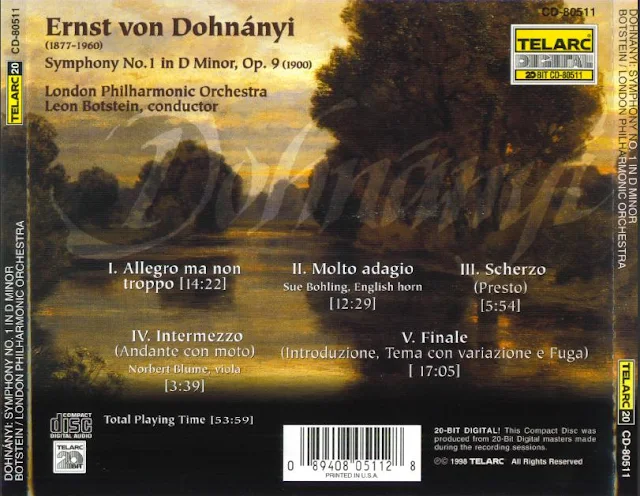
Richter, too, who in 1902 introduced Dohnányi’s Symphony No 1 in D
minor, in Manchester.
The great violinist Joachim, friend of
Brahms, was also friend to Dohnányi whom he invited to Berlin where the
composer was offered a professorship at the Hochshule in 1905. Ten years
there were paralleled and followed by various prestigious appointments
not only at the Budapest Academy but also as chief conductor of the
Philharmonic Orchestra, a position which he held for the best part of 25
years from 1919. In 1931 he became the musical director of Hungarian
Radio where he worked until 1944. With all these involvements he found
time not only for composition but also for selecting concert repertoire
with the aim of raising musical standards in Hungary. He gave as many as
120 performances there in one year. No wonder that Bartók saw in him a
leading provider of Hungarian musical life. For four decades Dohnányi
dominated the musical scene in his home country and beyond. It is to
Dohnányi’s credit that although his musical temperament and outlook were
very different from Bartók’s and Kodály’s he put his phenomenal
performing ability to their service. In fact he recognised Bartók’s
genius well before others and gave him practical support while his own
countrymen were predominantly hostile. His long-standing relationship
with America made him a welcome refugee when, after a few years stay in
Austria (1944-1948), he decided to leave Europe for the New World. There
he indefatigably continued his musical activities, not only in his
capacity as pianist/composer-in- residence at Florida State University,
but also as a touring performer. One of his last concerts was in 1956 at
the Edinburgh Festival. Working to the very end of his life, he died
during a recording session at the age of 83.
In this series
featuring ‘The Romantic Piano Concerto’, Dohnányi’s two works in this
form are fitting examples of the genre because he was throughout his
life a romantic both at heart and in his musical language. Although he
died as late as 1960 he had little to do with the musical developments
of the twentieth century. The two Concertos on this recording evoke a
world which belongs to the nineteenth century. Dohnányi continued to
compose in a style deeply rooted in the Austro-German classical
tradition exemplified by Brahms. His merit as a composer is that he was
able to prolong meaningfully the classico/romantic past, of which he was
one of the last practitioners, well into this century, both in his
chamber and orchestral music. This he did with elegance, wit, and
stylish virtuosity. The two Piano Concertos are fine examples of his
fluent mastery of form and instrumentation.
The Piano Concerto No
1 in E minor, from the years of 1897–8, follows the traditional
three-movement structure: fast-slow-fast. However, the first movement
Allegro is preceded by an introductory ‘Adagio maestoso’ whose main
theme is picked up, albeit in a modified way, by the first Allegro
subject proper. It is characterised by a diminished 5th drop resolving
upwards a minor second (E-A#-B). The structural importance of the
introductory Adagio maestoso gains marked significance as it is
reiterated at the end of the movement. There is nothing in the musical
language—that is, in the rhythm, melody, harmony and musical structure
as well as in the traditional orchestration—which Brahms would have
found unfamiliar.
The second movement, with its largely pizzicato
orchestral accompaniment, is in A minor. Its melodic contour is also
derived in a subtle way from the ‘Adagio maestoso’. The last
twenty-eight bars, during which the piano plays the opening theme
originally introduced by the orchestra with broad arpeggio chords
finally establishing the key of A major (known as ‘tierce de Picardi’),
is an old trick, but it works superbly.
The third movement,
Vivace, brings to its dramatic conclusion the opening Adagio maestoso
theme which, motto-like, gives unity to the whole composition. Of the
three movements this is perhaps the most Brahmsian in style with its
lush sixths and thirds. A chorale-like theme played by the orchestra
interrupts the flow of the cadenza. Then a frenetic coda in 6/8 is
approached via a series of trills. Finally the time signature changes
again, now to 2/4 Presto, leading the composition to its conclusion—not
in E minor, but in the triumphant E major.
The Piano Concerto No 2
in B minor belongs to the post-World War II years, 1946–7. Thus nearly
fifty years separate the two Concertos on this CD. The composer’s
compositional style, however, shows little change. It is amazing to
think that Bartók’s Third Piano Concerto was written two years before
this one. The first Allegro movement of this Concerto also opens with a
quasi-motto theme. There is something Hungarian to it both melodically
and rhythmically. Among several striking passages the one which stands
out is the ‘Poco meno mosso’ entry of a theme which more or less
dominates the second half of the movement.
The second movement,
‘Adagio poco rubato’, again evokes Hungarian, or rather a stylised
Hungarian gipsy style in G minor. It ends in G major with a gradually
speeded-up repetition of the note G in the orchestra, leading directly
without a break to the third movement, Allegro vivace. The ostinato G is
spiced by a minor second clash which gives backing to the entry of the
energetic main theme. The motto theme of the first movement reappears,
albeit en passant, over a long held E in the bass. This gives way to a
spirited unfolding of the material and the eventual conclusion of the
Concerto.
It is incorrect to suggest, as some do, that Dohnányi
bridged the gap in Hungarian music between Liszt and Bartók. This is not
so, since he did not share their innovating and pioneering
compositional genius. He got stuck in a style somewhere between Brahms
and Saint-Saëns. What he offers, however, is an unfailing romantic
spirit which to this day can evoke the musical values of yesterday,
which he served and defended with such inspired dedication. Hyperion
Ernő Dohnányi (1877-1960)
Piano Concerto No 1 in E minor Op 5 [44'56]
Piano Concerto No 2 in B minor Op 42 [29'44]
Conductor – Fedor Glushchenko
Leader [Orchestra] – Geoffrey Trabichoff
Orchestra – BBC Scottish Symphony Orchestra
Piano – Martin Roscoe
quarta-feira, 6 de março de 2024
DOHNÁNYI : Piano Concerto No 1 In E Minor • Piano Concerto No 2 In B Minor (Martin Roscoe · BBC Scottish Symphony Orchestra · Fedor Glushchenko) (1993) Serie The Romantic Piano Concerto – 6 | FLAC (image+.cue), lossless
domingo, 19 de novembro de 2023
sexta-feira, 20 de novembro de 2020
DOHNÁNYI, JANÁCEK : Violin Sonatas (Shaham-Erez) (2009) FLAC (image+.cue), lossless
The violin sonatas, and indeed the vast majority of the works for violin and piano, by Dohnányi and Janácek are rarely performed in the concert hall and even less frequently recorded. Neither of the sonatas represent the pinnacle in either composer's compositional arsenal. Dohnányi's contribution, like many of his works, is highly romantic with lush melodies and rich harmonies. Janácek also does not stray far from his norm with sonatas featuring many fragmentary melodies and angular harmonies. In both cases, performances by musicians who do not have a clear plan as to their execution leave listeners struggling to digest exactly what' going on in the music. This Hyperion album with violinist Hagai Shaham and pianist Arnon Erez is sadly no different. Both Shaham and Erez possess a reasonably strong technique (although Shaham's intonation is sometimes shaky), but both seem to be doing their thing and rarely meeting up in the middle to produce something that can truly be considered chamber music. The duo also tends to focus on the often overwrought nature of their entire program, accentuated with intense, non-stop vibrato, exaggerated accents, and slides into big shifts, rather than giving listeners a break with a bit of simplicity and delicacy. There's just not enough clear-cut direction and intentionality to their playing, and certainly not enough of a unified concept of the score, to elevate these works to a position tantamount to others written around the same time. by Mike D. Brownell
quarta-feira, 26 de agosto de 2020
MARTINU • KODÁLY • DOHNÁNYI • JOACHIM • ENESCU : Music for Viola and Piano (Bradley-Hewitt) (2011) FLAC (image+.cue), lossless

From the end of the 19th century and onward, the frequency with which prominent composers were found writing for the viola increased dramatically. This phenomenon was seen around the world as the instrument's deep, resonate sound fell more into favor and virtuosos became more commonplace. This Naxos album focuses on viola works to emerge from Hungary. From this country, composers often fell into two camps. The first were those who adopted the popular late-Romantic, German idiom; here, this is represented by the Joachim Op. 9 Hebrew Melodies and the Dohnányi Op. 21 Sonata in an arrangement by performer Sarah-Jane Bradley. (Dohnányi himself had played an arrangement of the piece with violist Lionel Tertis). Countering these highly lyrical compositions are those from composers who sought to develop a more nationalistic musical idiom and include the Martinu Sonata, H. 355, the Kodály Adagio, and the Enescu Concertstück. Bradley's program is not only well thought out and diverse, but demonstrates the viola's abilities both as a virtuosic instrument and one capable of delivering beautiful melodic lines. Joined by pianist Anthony Hewitt, Bradley's performances are admirable in many respects. Her playing is very calm and restrained; there are no moments when listeners are left gasping for air as the violist strains for large shifts or to make it to the end of difficult passagework. Her intonation is generally solid, her tone is warm and even across the range of her instrument. On the downside, her sound is not exceptionally big. Hewitt's playing is quite accommodating in this respect so the piano never actually obscures Bradley's playing, but there is a notable lack of any big, forte sound, or a wide dynamic range. by Mike D. Brownell

domingo, 26 de julho de 2020
DOHNÁNYI : Piano Concertos Nos. 1 & 2 (Shelley-Bamert) (2002) FLAC (tracks+.cue), lossless
Ernst (or Ernö) von Dohnányi was Bartók's classmate, saw his music dismissed by the Nazis as too Hungarian (and, moreover, related by marriage to Dietrich Bonhoeffer) and by the Hungarian Communists as not Hungarian enough, and ended up as a teacher at Florida State University. He suffered a final indignity when modernist fundamentalists rejected his music as too conservative, but a modest revival has been helped along by the fame of his grandson, conductor Christoph von Dohnányi. The two piano concertos here could each be programmed by a middle-rung symphony orchestra and visiting pianist and would send an audience home happy. Although they were composed almost 50 years apart, they are recognizably similar in structure. Both first movements introduce the piano early and use it to subject the orchestral material to lively questioning in complex, rather episodic dialogues. The middle movements are lushly lyrical, and the finales are more motoric, with the sole hints of Hungarian flavor in a generally Brahmsian style. Originally recorded in 2002 and 2004, the two concertos were put together in a sensible 2010 reissue. British pianist Howard Shelley and the BBC Philharmonic under veteran conductor Matthias Bamert deliver engaging, not overly sentimental readings that fit the music, and the Chandos sound is unimpaired in the reissue. At a budget price this is a nice find for those interested in national styles, or, indeed, any lover of the late Romantic concerto. by James Manheim

DOHNÁNYI : String Quartet No. 3; Serenade for String Trio; Sextet for Piano, Clarinet, Horn & String Trio (The Nash Ensemble) (2018) FLAC (image+.cue), lossless

The music of Hungarian composer Ernst von Dohnányi took a dive in concert program frequency after his death in the U.S. in 1960, when the fashion was for Bartók or still more progressive composers. It has been making a comeback, however, and this satisfying release by Britain's venerable Nash Ensemble, largely specialists in contemporary music, should only help it along. Dohnányi was classified as a conservative, and indeed there is a strong Brahmsian streak in his music. Yet the more you listen to it, the more prominent the Hungarian streak seems, and it is no surprise to learn that both Bartók and Kodály attested to the importance of Dohnányi's influence. By 1926, when Dohnányi wrote the String Quartet No. 3 in A minor, the influence was going the other way; Bartók especially can be heard in the angular opening Allegro agitato e appassionato movement. But the framing of the two less intense works around the string quartet is effective. Sample the finale of the Sextet for piano, clarinet, horn, and string trio in C major, Op. 37, of 1935: it is in the Brahmsian line, doubtless, but its combination of textural complexity and rhythmic drive are all Dohnányi's own. What's needed in this music is an experienced chamber group that brings clarity, and that's exactly what it gets from the Nash Ensemble. Recommended. by James Manheim

segunda-feira, 15 de junho de 2020
segunda-feira, 9 de dezembro de 2019
ERNÖ DOHNÁNYI : The Complete Solo Piano Music, Vol. 1 (Martin Roscoe) (2011) FLAC (tracks), lossless

Ernö Dohnányi's music fell out of fashion when Bartók became the modern composer the avant-garde and the general classical audience could all agree on, but much of it has an elegant charm. Moreover, the two large sets of piano works on this album offer a part of the missing link between Liszt and Bartók: they are late Romantic in conception and generally in harmony, but the emphasis is on structure rather than expression, and they are not especially virtuosic. Consider "An Ada" (track 7) from the set of ten bagatelles entitled Winterreigen (Winter Rounds). It is built on the interval of a fourth, to which slightly differing counterpoints are added, and it's easy to imagine the young Bartók beginning to abstract patterns like this one. The Winterreigen and the Four Rhapsodies, Op. 11, at the beginning of the program are the most interesting, but the Pastorale (track 15) could easily fit on a program of unusual Christmas music. Pianist Martin Roscoe, a specialist in Dohnányi's music who earlier recorded this exact program for the ASV label, approaches the music with a quiet, precise confidence that serves it very well. Recommended for anyone interested in the fin de siècle, but especially for pianists who are looking for something striking and little-known to add to a recital: nearly everything on the program here will fill the bill. by James Manheim
quinta-feira, 28 de novembro de 2019
ERNÖ DOHNÁNYI : The Complete Solo Piano Music, Vol. 2 (Martin Roscoe) (2011) FLAC (tracks), lossless

Ernö von Dohnányi, who lived from 1877 to 1960, was a composer-pianist in the classic Central European mold. His work fell out of fashion during modernist rule but has bounced back to a degree, and his family continues to influence the course of American music. British pianist Martin Roscoe has embarked on a series of recordings covering his complete solo piano music. Such series, especially in individual albums covering a composer's early music (such as this one), can easily seem too much, but the music here runs from enjoyable to revelatory. Each item dates from Dohnányi's student years or shortly after, and all of it is influenced by Brahms. Yet even in the Four Piano Pieces, Op. 2, there is an individual voice. The Variations and Fugue on a Theme by EG, Op. 4 (the EG refers to the work's dedicatee, Emma Gruber), is perhaps the most academic exercise, but the undoubted highlight is the set of Humoresques in the form of a suite, Op. 17, composed in 1907. The work uses a cheerful mixture of antique forms from pavane to fugue, and it draws on the embryonic neo-classicism to be found in Brahms' music. But it has a lyrical impulse that is entirely Dohnányi's own, and the lovely Pastorale (track 10) is worth the price of admission. The final Valses nobles are also intriguing; based on Schubert's waltzes (D. 969), they are neither transcriptions nor variations but somewhere in between, adding fairly elaborate new counterpoints to Schubert's pieces but retaining the original notes. With superior acoustics from Potton Hall in Britain's Suffolk region, this is an enjoyable introduction to a little-known composer. by James Manheim
terça-feira, 19 de novembro de 2019
ERNÖ DOHNÁNYI : The Complete Solo Piano Music, Vol. 3 (Martin Roscoe) (2015) FLAC (image+.cue), lossless
segunda-feira, 18 de novembro de 2019
ERNÖ DOHNÁNYI : The Complete Solo Piano Music, Vol. 4 (Martin Roscoe) (2018) FLAC (tracks), lossless

British pianist Martin Roscoe's survey of Ernö Dohnányi's solo piano music has ranged from worthwhile to revelatory and has helped to place the composer firmly among those unfairly neglected by the modernist nomenklatura. This final installment consists of a variety of pieces held together, in the words of annotator and Dohnányi specialist James A. Grymes, by the idea of demonstrating "Dohnányi's lifelong efforts to solidify his place in the great lineage of composer-pianists by writing in genres in which his predecessors excelled...." Thus you get etudes, character pieces, a passacaglia, and other experiments in Baroque dance forms. There aren't quite the unknown masterpieces here that there are on some of the other albums, but those whose interest has been piqued will enjoy the album. The Six Pieces, Op. 41, were written after the end of World War II in a small town in Austria where Dohnányi had taken refuge; sample Cloches, which deploys the sound of church bells to represent the composer's feelings upon learning that his son had died in a Russian prison camp. The Six Concert Études are in the Chopin tradition but are full of the harmonic surprises and angular rhythms that are characteristic of Dohnányi's style: he never goes quite in the directions that Bartók went, but he is unmistakably Hungarian. The Passacaglia in E flat minor of 1899 derives from the finale of the Brahms Symphony No. 4 in E minor, Op. 98; it was partially improvised by Dohnányi at its premiere, and Roscoe's performance gives an idea of what must have been the composer's considerable charisma at the keyboard. The Suite in the Olden Style of 1913, a time when the neoclassic movement was just gathering steam, is paradoxically perhaps the most "progressive" piece on the album. Beautifully recorded, and recommended for anyone interested in Hungarian music. by James Manheim