For its acclaimed series of the Romantic Piano Concerto, Hyperion has
delved deeply into the most obscure areas of the repertoire to extract
odd gems that still have some sparkle, in spite of the thick dust of
neglect. Volume 59 presents three works by Polish composers, the Piano
Concerto in E flat major of Wladyslaw Zelenski, along with the Piano
Concerto in A flat major and the Grand Polonaise in E flat major of
Aleksander Zarzycki. These works are virtually unknown today, even in
Poland, and while they reflect the influences of major 19th century
composers -- Chopin above all, followed by Brahms, Liszt, and
Saint-Saëns -- they show little originality and seem rather routine.
This is not to say that they are incompetently written or unappealing,
because they feature plenty of flashy passagework, and the orchestral
writing is vivid enough to hold one's attention. The performances by
pianist Jonathan Plowright and the BBC Scottish Symphony Orchestra, led
by Lukasz Borowicz, are grand displays of virtuoso showmanship, backed
by a vigorous orchestral accompaniment with touches of flamboyance.
While the pieces will be utterly new to the majority of listeners, there
are sufficient conventions and clichés of the concerto genre that no
one will feel lost while hearing them. Hyperion's reproduction is
exceptional, and the centrally placed piano has a strong presence in
front of the robust orchestra. Blair Sanderson
For its acclaimed series of the Romantic Piano Concerto, Hyperion has
delved deeply into the most obscure areas of the repertoire to extract
odd gems that still have some sparkle, in spite of the thick dust of
neglect. Volume 59 presents three works by Polish composers, the Piano
Concerto in E flat major of Wladyslaw Zelenski, along with the Piano
Concerto in A flat major and the Grand Polonaise in E flat major of
Aleksander Zarzycki. These works are virtually unknown today, even in
Poland, and while they reflect the influences of major 19th century
composers -- Chopin above all, followed by Brahms, Liszt, and
Saint-Saëns -- they show little originality and seem rather routine.
This is not to say that they are incompetently written or unappealing,
because they feature plenty of flashy passagework, and the orchestral
writing is vivid enough to hold one's attention. The performances by
pianist Jonathan Plowright and the BBC Scottish Symphony Orchestra, led
by Lukasz Borowicz, are grand displays of virtuoso showmanship, backed
by a vigorous orchestral accompaniment with touches of flamboyance.
While the pieces will be utterly new to the majority of listeners, there
are sufficient conventions and clichés of the concerto genre that no
one will feel lost while hearing them. Hyperion's reproduction is
exceptional, and the centrally placed piano has a strong presence in
front of the robust orchestra. Blair Sanderson
Tracklist :
Piano Concerto In E Flat Major Op 60 (34:00)
Composed By – Władysław Żeleński
Piano Concerto In A Flat Major Op 17 (17:21)
Composed By – Aleksander Zarzycki
Grande Polonaise In E Flat Major Op 7 4:32
Composed By – Aleksander Zarzycki
Credits :
Leader – Kanata Ito
Orchestra – BBC Scottish Symphony Orchestra
Piano – Jonathan Plowright
Conductor – Łukasz Borowicz
sábado, 20 de janeiro de 2024
ZELENSKI : Concerto In E Flat Major, Op. 60 ♦ ZARZYCKI : Concerto In A Flat Major, Op. 17 • Grande Polonaise, Op. 7 (Jonathan Plowright · BBC Scottish Symphony Orchestra · Łukasz Borowicz) (2013) Serie The Romantic Piano Concerto – 59 | FLAC (image+.cue), lossless

segunda-feira, 15 de janeiro de 2024
Różycki : Piano Concerto No 1, Op 43 • Piano Concerto No 2 • Ballade, Op 18 (Jonathan Plowright · BBC Scottish Symphony Orchestra · Łukasz Borowicz) (2016) Serie The Romantic Piano Concerto – 67 | FLAC (tracks+.cue), lossless
 Hyperion's large Romantic Piano Concertoseries (this is the 67th volume)
has yielded a lot of fair-to-middling music and a few gems. This
release of music by Ludomir Rózycki, unknown outside his native Poland,
fits into the latter category. Yes, it's true that the Ballade in G
minor, Op. 18, is harmonically conservative for 1904, to say nothing of
the Piano Concerto No. 1 in G minor, Op. 43, of 1917-1918 and the World
War II-era Piano Concerto No. 2. All these pieces are essentially late
Romantic in style. But none is derivative or stale. The Ballade is a
student work, but already captures the essence of Rózycki's style, which
infuses great spontaneity into traditional forms. Note especially the
delightfully understated conclusion to this work. The first movement of
the Piano Concerto No. 1 (track two) makes a good place to start when
sampling the album. It has a slow introduction of a sort, but with an
unusual conversational quality that seems organically linked to the
explosive "Allegro" that follows with syncopated figures. The second
movement of this concerto is as close as Rózycki comes to straight
Romantic melody, but even here he offers unexpected divagations. The
Piano Concerto No. 2 is a more personal work, quoting some of the
composer's own songs; the booklet notes are useful in understanding
what's happening, but in general this work too has a feeling of total
freedom in the use of conventional forms. The level of virtuosity is
very high but poses no problems for pianist Jonathan Plowright, and the
BBC Scottish Symphony Orchestra under Lukasz Borowicz gets the
spontaneous quality of the music. An entirely satisfying album of music
that ought to inspire further performances of these pieces in concert. James Manheim
Hyperion's large Romantic Piano Concertoseries (this is the 67th volume)
has yielded a lot of fair-to-middling music and a few gems. This
release of music by Ludomir Rózycki, unknown outside his native Poland,
fits into the latter category. Yes, it's true that the Ballade in G
minor, Op. 18, is harmonically conservative for 1904, to say nothing of
the Piano Concerto No. 1 in G minor, Op. 43, of 1917-1918 and the World
War II-era Piano Concerto No. 2. All these pieces are essentially late
Romantic in style. But none is derivative or stale. The Ballade is a
student work, but already captures the essence of Rózycki's style, which
infuses great spontaneity into traditional forms. Note especially the
delightfully understated conclusion to this work. The first movement of
the Piano Concerto No. 1 (track two) makes a good place to start when
sampling the album. It has a slow introduction of a sort, but with an
unusual conversational quality that seems organically linked to the
explosive "Allegro" that follows with syncopated figures. The second
movement of this concerto is as close as Rózycki comes to straight
Romantic melody, but even here he offers unexpected divagations. The
Piano Concerto No. 2 is a more personal work, quoting some of the
composer's own songs; the booklet notes are useful in understanding
what's happening, but in general this work too has a feeling of total
freedom in the use of conventional forms. The level of virtuosity is
very high but poses no problems for pianist Jonathan Plowright, and the
BBC Scottish Symphony Orchestra under Lukasz Borowicz gets the
spontaneous quality of the music. An entirely satisfying album of music
that ought to inspire further performances of these pieces in concert. James Manheim
Tracklist :
Ballade In G Major Op 18 10:35
Composed By – Ludomir Różycki
Piano Concerto No 1 In G Minor Op 43 (31:43)
Composed By – Ludomir Różycki
Piano Concerto No 2 (20:52)
Composed By – Ludomir Różycki
Credits :
Conductor – Łukasz Borowicz
Leader – Laura Samuel
Orchestra – BBC Scottish Symphony Orchestra
Piano – Jonathan Plowright
terça-feira, 2 de janeiro de 2024
GABLENZ : Piano Concerto In D Flat, Op 25 ♦ PADEREWSKI : Polish Fantasy, Op 19 (Jonathan Plowright • BBC Scottish Symphony Orchestra • Łukasz Borowicz) (2021) Serie The Romantic Piano Concerto – 83 | FLAC (tracks), lossless
 This entry is volume 83 in the Hyperion label's Romantic Piano Concerto
series, which shows just how much neglected music is out there. There
are several attractions this time around on this recording of Polish
piano concertos. One is the presence of the Piano Concerto in D flat
major, Op. 25, of Jerzy Gablenz, which is a genuine rarity; Gablenz,
booklet readers learn, was preoccupied with his management job at a
pickle factory and lacked time to devote to his musical career. The work
was not premiered until 1977 in the Dominican Republic. It's an
imposing work with a 24-minute opening movement that can't quite cash
the structural checks it writes; the Andante cantabile middle movement,
with its novel glockenspiel strokes, is more memorable. However, the
work certainly belongs in the repertory, and the big virtuosi should
take note. They should also note pianist Jonathan Plowright's reading of
the Polish Fantasy, Op. 19, of Ignace (Ignacy) Jan Paderewski. The
great Paderewski was certainly capable of keyboard heroics, but here,
he's about something different, namely an extension of Chopin's
experiments with keyboard textures. There's less keyboard pounding than
sprightly ornamentation, and Plowright's reading is exceptionally
lively; he suggests not only the power but also the spontaneity that
must have drawn audiences to the great Pole in his time. With properly
circumspect backing from the BBC Scottish Symphony under Lukasz Borowicz
and fine idiomatic sound from the Glasgow Town Halls, this is a strong
entry in Hyperion's series. James Manheim
This entry is volume 83 in the Hyperion label's Romantic Piano Concerto
series, which shows just how much neglected music is out there. There
are several attractions this time around on this recording of Polish
piano concertos. One is the presence of the Piano Concerto in D flat
major, Op. 25, of Jerzy Gablenz, which is a genuine rarity; Gablenz,
booklet readers learn, was preoccupied with his management job at a
pickle factory and lacked time to devote to his musical career. The work
was not premiered until 1977 in the Dominican Republic. It's an
imposing work with a 24-minute opening movement that can't quite cash
the structural checks it writes; the Andante cantabile middle movement,
with its novel glockenspiel strokes, is more memorable. However, the
work certainly belongs in the repertory, and the big virtuosi should
take note. They should also note pianist Jonathan Plowright's reading of
the Polish Fantasy, Op. 19, of Ignace (Ignacy) Jan Paderewski. The
great Paderewski was certainly capable of keyboard heroics, but here,
he's about something different, namely an extension of Chopin's
experiments with keyboard textures. There's less keyboard pounding than
sprightly ornamentation, and Plowright's reading is exceptionally
lively; he suggests not only the power but also the spontaneity that
must have drawn audiences to the great Pole in his time. With properly
circumspect backing from the BBC Scottish Symphony under Lukasz Borowicz
and fine idiomatic sound from the Glasgow Town Halls, this is a strong
entry in Hyperion's series. James Manheim
Tracklist :
Piano Concerto in D flat major Op. 25
Jerzy Gablenz
Fantaisie polonaise sur des thèmes originaux Op. 19
Ignace Jan Paderewski
Credits :
Jonathan Plowright - Piano
BBC Scottish Symphony Orchestra
Lukasz Borowicz - Conductor
quinta-feira, 5 de novembro de 2020
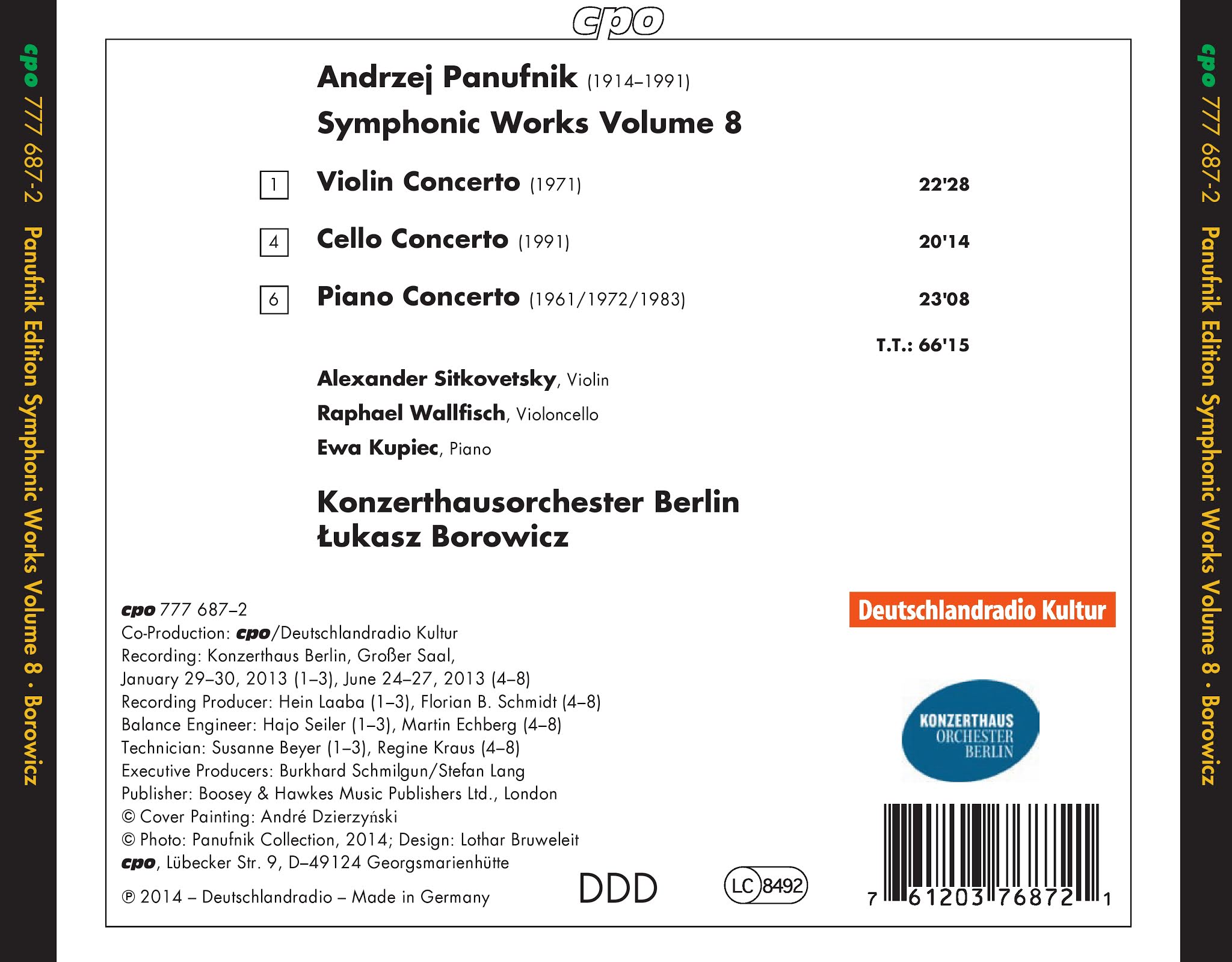
ANDRZEJ PANUFNIK : Nocturne - Symphonic Works, Vol. 1 (Borowicz) (2010) FLAC (tracks+.cue), lossless

The six pieces on this program have not been recorded often. Prior to the release of this disc, the Heroic Overture had three recordings; the Nocturne had two; the Tragic Overture, the Katyn Epitaph, and Harmony had one recording apiece; and A Procession for Peace has never been recorded before. But all of them are magnificently played here. Lukasz Borowicz and the Polish Radio Symphony Orchestra give everything they've got to the music, and the result is not only wholly compelling from start to finish, it easily outclasses virtually all previous performances of these pieces. Each work here, while characteristic of the composer, is distinctive. The Tragic Overture is stark and relentless, the Nocturne is dark and sinister, the Heroic Overture is mighty and majestic, the Katyn Epitaph is harsh and demanding, and Harmony is smooth, sleek and silky, while the world-premiere A Procession for Peace turns out to be a powerful tonal march with brass and percussion well to the fore. Thus, any fan of Panufnik should by all means try this disc, and any fan of postwar modernism probably should, too. CPO's digital sound is cool but clear. by James Leonard


ANDRZEJ PANUFNIK : Speranza - Symphonic Works, Vol. 6 (Borowicz) (2013) FLAC (tracks+.cue), lossless
 Polish composer Andrzej Panufnik departed for Britain in 1954, when the Communist experiment in Poland began to go sour. His music, though, remained more Polish than British. At times he seems to have aimed at a somewhat simpler version of the style of his friend Witold Lutoslawski, with whom he played duets in Warsaw cafes during the darkest days of World War II (concerts and other public gatherings being forbidden). His later works often involve the use of small melodic cells, heavily manipulated. Panufnik's Symphony No. 9 ("Sinfonia di Speranza") was commissioned in 1986 for the 175th anniversary of the Royal Philharmonic Society. The orchestra suggested a choral work on the model of Beethoven's Symphony No. 9 in D minor, Op. 125. Panufnik rejected the suggestion, but the 40-minute symphony, although not tonal, seems to have characteristics of both the first movement and the chorale finale, with its reworked and ultimately triumphal musical motif of hope (the work's subtitle means "symphony of hope"). With a little help from the booklet notes, which are largely quoted from Panufnik's own writings about the work, the music is quite accessible. There is a six-note "hope" motif, falling into two halves, that appears at the beginning of the work in various melodic and rhythmic guises, falls away in a central section that Panufnik calls "cold"), and returns for a stirring finale. The performance here by the Konzerthausorchester Berlin under Lukasz Borowicz captures the essentially Romantic quality of the work, despite its modern harmonic world and theoretical basis, and CPO's sound engineering, executed on the orchestra's home ground of the Konzerthaus Berlin, is very strong. The very colorful Concertino for timpani, percussion, and strings, with an unusually melodic timpani part originally premiered by the great Evelyn Glennie, is a thoroughly enjoyable curtain-raiser, and either work on the program here might serve an orchestra well for contemporary programming that makes no crossover concessions but should be accessible to a wide range of audiences. by James Manheim