Mostrando postagens com marcador Christoph Poppen. Mostrar todas as postagens

quinta-feira, 11 de abril de 2024

Martinů • Hindemith • Honegger : Cello Konzerte (Johannes Moser · Deutsche Radio Philharmonie · Christoph Poppen) (2011) FLAC (image+.cue), lossless

Though their national heritages differed as widely as their musical backgrounds and mature musical language, contemporaries Martinu, Hindemith, and Honegger each turned their backs on the highly popular and influential serial movement and blazed their own paths. Their cello concertos serve as ideal illustrations; from the Czech infused rhythmic intensity of the Martinu to the lean, academic focus of the Hindemith, to the nearly palpable colors and textures of Honegger, these three concertos are highly individualistic yet work quite well together on a disc. Cellist Johannes Moser appears again on the Hänssler Classic label along with the Deutsche Radio Philharmonie under Christoph Poppen for performances as vibrant and intriguing as the compositions themselves. This type of music -- which combines elements of both demanding technical bravura across the range of the instrument with moments of passionate lyrical beauty -- seems to be Moser's forte. His left hand here is staggeringly precise, no matter how big the shift, how awkward the chord, or how rapid the passagework. This technical ease allows listeners to remove their attention from the actual execution of the score and instead focus on the enjoyable musical content. Moser's sound is quite powerful, though never forced, and from low to high pitches he penetrates the sometimes dense orchestration with ease. Poppen's orchestra is just as precise and nuanced as Moser, and their collaboration results in a truly enjoyable listening experience. Mike D. Brownell 

segunda-feira, 11 de março de 2024

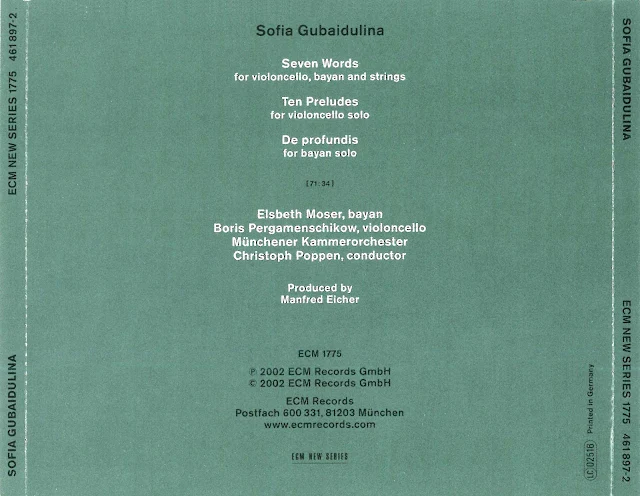
SOFIA GUBAIDULINA : Seven Words • Ten Preludes • De profundis (Elsbeth Moser · Münchener Kammerorchester · Christoph Poppen) (2002) FLAC (image+.cue), lossless

“There is no more important reason for composing music than spiritual renewal.” –Sofia Gubaidulina.

Shostakovich once famously said of his student, Sofia Gubaidulina, “I want you to continue along your mistaken path.” Mistaken, that was, in the former Soviet Union, where the deliverance preached through her devout composing sat uncomfortably with censors. So much so that when she composed her Seven Words in 1982, she was obliged to leave out “…of Our Savior on the Cross” from its title. Nevertheless, this riveting work is one of the twentieth century’s reigning masterpieces. One will want to compare Gubaidulina’s instinctive metaphorical approach to Haydn’s more direct setting of the same. The two could hardly be more different, either in sound or in circumstance, but they clearly embrace the same fragile heart. Providing the blood herein is the bayan, a button accordion typically heard in Russian folk contexts. Through Gubaidulina’s notecraft, and in the hands of longtime associate Elsbeth Moser, it becomes a speech act in its own right. In constant dialogue with a cello soloist and tentative orchestral commentary, the bayan comports itself not unlike the turbulent waves on the album’s sleeve. And while there are far too many moments to single out for praise, the epiphany of Part VI (“It is finished”) is a wondrous experience indeed, and leads us to an ending that is beyond earthly.

The following Ten Preludes (1974, rev. 1999) for cello were originally conceived as instructional etudes, with the final piece leaving room for improvisation, and therefore the creative edge of the performer. Inevitably, these have taken on lives of their own, and flow here in a line of fractured counterpoint that “resets” us for the heavenly strains of De profundis (1978) for bayan alone. The instrument’s multilayered sound lends itself beautifully to the Trinitarian gaze in which it finds itself illuminated, lapsing into trundled passages where lateral divisions turn our souls to the indecipherable limits of their own awareness.

There is no ground on which to stand in this music. One must remain elevated, if not airborne, in relation to one’s expectations, always approaching them from above. It is a revelation to finally have Gubaidulina’s music represented on ECM, where spacious production values give it all the berth it needs. Let us hope this is not a one-off affair. web
Tracklist :
The Seven Last Words, for cello, bayan & strings
Preludes (10) for cello
Musicians
Elsbeth Moser - bayan
Boris Pergamentschikow - cello
Münchener Kammerorchester
Christoph Poppen - conductor
Recorded January 2001, Himmelfahrtskirche Sendling, München
Produced by Manfred Eicher

segunda-feira, 3 de agosto de 2020

J. S. BACH : Morimur (The Hilliard Ensemble-Christoph Poppen) (2001) APE (image+.cue), lossless

It was quite popular, in the Baroque era, to use numbers and equations for riddles and the hiding of messages; and the study of J.S. Bach's work has revealed that he used numbers symbolic of notes in the major and minor scales formulated into equations and then composed his works around these equations. It was with one such series of equations that researchers found that inside of J.S. Bach's music there was a large number of other compositions almost fractally entwined. Of particular interest was J.S. Bach's "Six Sonatas and Partitas for Solo Violin" which had been designed with a sort-of numeric equation that turned out to actually have the music fractally built around a very small part. Intrigued by researcher's findings Christoph Poppen discussed with ECM Records head and producer Manfred Eicher the possibility of a recording that would make the "hidden chorales" as the smaller, fractal pieces were later termed, more audible. A collaboration with the excellently gifted interpreters of early music, the Hilliard Ensemble was proposed and with Christoph Poppen directing they set about liberating the numeric/ melodic equations from the fabric of J.S. Bach's "Partita No. 2". With Morimur for the first time we hear the music the way that J.S. Bach might have heard it when he was composing his "Partita No. 2 as they are linked with various chorales that also used the numeric equation that is found in "Partita No. 2". Beyond the fascinating story behind Morimur it's an excellently well crafted, and well-produced recording that truly brings the piece to life. If you're a fan of J.S. Bach it is recommended that you give this recording a listen as it is fantastic and excellently read with the Hilliard Ensemble in top form. A must have for your collection!. by Matt Borghi