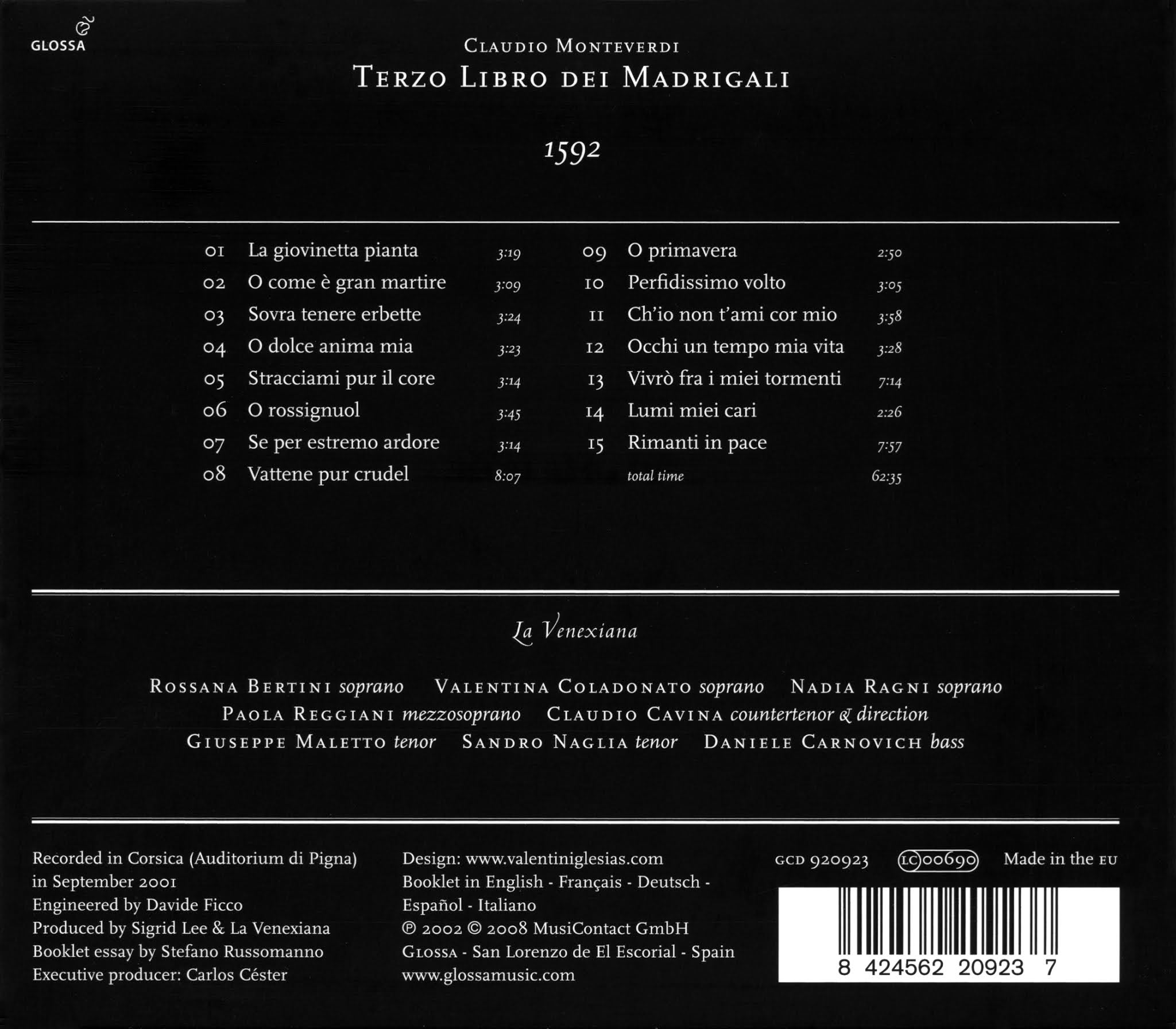
There are no star performers in La Venexiana and the approach to both singing and sound is consistent throughout. Secondo Libro del Madrigali was recorded in the Basilica of San Gaudenzio in Novara and is a little quiet in volume, but the voices blend very well with no sharp edges. The bass in La Venexiana, Daniele Carnovich, is in particular outstanding and deserves singling out, but overall Secondo Libro del Madrigali seems to touch all the right bases in terms of what Monteverdi intends to convey through the music. The second book of 1590 contains early Monteverdi madrigals and includes some individual pieces that remain among the most popular of his short works in this genre. If one is looking for a single disc out of Glossa's Monteverdi Edition in order to sample the whole project, this is a good place to start. by Uncle Dave Lewis


With the release of Monteverdi's Fifth Book of Madrigals, La Venexiana, the extraordinary ensemble founded and led by countertenor Claudio Cavina, comes close to completing its cycle of Monteverdi's nine volumes for Glossa, with only the first and last books left to record. The Fifth Book, published just before Monteverdi wrote Orfeo, is a pivotal collection that incorporates conventions both of Renaissance madrigals and of the emerging Baroque. La Venexiana's performance is notable for its musical and emotional intensity. The singers' remarkably pure and focused tone is piercing in its clarity, and their expressive directness fully captures the extreme affects of the text. Nothing in the performance is static; every sustained note is purposefully and lovingly contoured, and the phrasing has the rhythmic fluidity that Monteverdi considered essential to effective performance of his vocal music. Even a warhorse like "Cruda Amarilli" sounds fresh and newly imagined. Each of the singers has a voice of solo quality -- beautiful, warm, and shapely -- and their choral blend is ravishing. The second half of the collection has continuo accompaniment, and the somewhat eccentric combination of harp and harpsichord offers a pleasing alternative to the standard keyboard with gamba or cello. Glossa's sound is remarkably intimate and present; being able to hear the singers' intake of breath only adds to the immediacy of the performance. by Stephen Eddins

Claudio Monteverdi's late works, like those of Beethoven, contain singular mixtures of simplicity and complexity. Book Eight of his madrigals are about love and war, themes as elemental as they come. Yet consider the madrigal Ogni amante è guerrier (Every Lover is a Warrior, track 6 on the first CD of this set), with its text by Ottavio Rinuccini that subtly conflates the two ideas. Monteverdi's setting, for a low voice, is moody, involved, and philosophical. The Italian early Baroque specialist group La Venexiana plays up these traits with a slow tempo that stretches the work out to nearly a 15-minute length. The later Monteverdi madrigals, for solo voice or voices and the continuo, lend themselves to a variety of interpretations, and there are several good recordings despite the demands of the music. La Venexiana's readings are restrained, with eyes cast backward toward the intellectual qualities of the Renaissance madrigal. The churning instrumental work and vocal fireworks heard in many Monteverdi performances are almost completely absent. Tempos are slow throughout, and this set is the better part of an hour longer than the René Jacobs recording. If pieces like the famed Combattimento di Tancredi e Clorind seem to lack the proper level of intensity, the lovingly detailed Lamento della Ninfa (CD 3, track 3) and many of the more arcane pieces have an intense, hypnotic effect. Perhaps the best way to think about this recording is to imagine it as chamber-sized and madrigal-esque, while those by Jacobs and Rinaldo Alessandrini and Jacobs are garden-sized and operatic. Monteverdi works either way, but this is the set to have if you are deeply into Monteverdi and want to contemplate the mysteries of his career at two in the morning. by James Manheim


After a flirtation with the 19th century, soprano Simone Kermes is back on familiar Baroque ground, with a new collection that is once again organized around a theme rather than a place or time or technique. Indeed, Kermes is resolutely not after an ideal of historical performance; she draws together material from four different national traditions (English, French, Spanish, and Italian), and she has one of the players in her small La Magnifica Comunità orchestra rearrange pieces at will to fit the sequence of events in the program. Kermes has the chops to carry off this kind of freedom. Her voice is utterly distinctive and may be a matter of taste, but there are some wonderful pieces here, each of them introduced in the booklet by a trio of adjectives ("Clandestine love -- bashfulness -- inexperience," for Michel Lambert's Sombres déserts, track six). There is a striking range of moods and of vocal qualities to go with them. The program ends with and in some ways builds to Purcell's "When I am laid in earth," which receives a performance of great gravity, but equally interesting if not more so are the obscure pieces that Kermes shapes into a tour of the dangerous emotion. Sample "Che si può fare? ("Yearning -- compassion -- despair," track five) by Barbara Strozzi, who is still more talked about than performed; it's a deliciously messy and modern piece. This is a very strong recital, as well executed as it is original. by James Manheim
Tracklist:
Lamento della ninfa, SV 153
1 Amor, amor 4:24
Claudio Monteverdi
2 Folle è ben che si crede 2:59
Tarquinio Merula
3 Quelles beautés, ô mortels (Récit de Mnémosyne) 2:31
Antoine Boësset
4 Ay amor loco 3:09
Luis de Briçeño
5 Che si può fare? 4:23
Barbara Strozzi
6 Sombres déserts 3:13
Michel Lambert
The Fairy Queen, Z. 629
7 If Love's a Sweet Passion 2:08
Henry Purcell
8 Grida l'alma a tutt' ore 2:31
Francesco Manelli
9 Frescos ayres del prado 4:37
Antoine Boësset
10 Chi vuol ch'io m'innamori 2:22
Tarquinio Merula
11 Chi mi tolse alle sfere!... Lumi, potete piangere 3:32
Giovanni Legrenzi
12 I burn, I burn 3:22
John Eccles
13 Disserratevi, abissi 4:58
Antonio Cesti
14 Restless in thoughts 7:44
John Eccles
15 Now, O now I needs must part 5:07
John Dowland
16 Più bella maestà... Dormi, dormi, ben mio 3:39
Antonio Cesti
Dido & Aeneas, Z. 626
17 Thy Hand Belinda...When I am laid in earth (Dido's Lament) 4:36
Henry Purcell