Tracklist :
Silenzio
1 Part 1 5:09
Accordion – Geir Draugsvoll
Cello – Henrik Brendstrup
Violin – Arne Balk Møller
2 Part 2 2:38
Accordion – Geir Draugsvoll
Cello – Henrik Brendstrup
Violin – Arne Balk Møller
3 Part 3 2:28
Accordion – Geir Draugsvoll
Cello – Henrik Brendstrup
Violin – Arne Balk Møller
4 Part 4 1:31
Accordion – Geir Draugsvoll
Cello – Henrik Brendstrup
Violin – Arne Balk Møller
5 Part 5 8:03
Accordion – Geir Draugsvoll
Cello – Henrik Brendstrup
Violin – Arne Balk Møller
6 De Profundis - For Classical Accordion Solo (1978) 11:31
Accordion – Geir Draugsvoll
Et Exspecto
7 Part 1 2:42
Accordion – Geir Draugsvoll
8 Part 2 3:22
Accordion – Geir Draugsvoll
9 Part 3 5:51
Accordion – Geir Draugsvoll
10 Part 4 4:00
Accordion – Geir Draugsvoll
11 Part 5 1:30
Accordion – Geir Draugsvoll
12 In Erwartung - For Saxophone Quartet And Six Percussionists (1994) 17:58
Alto Saxophone – Harry Kinross White
Baritone Saxophone – Linda Bangs
Ensemble – Raschèr Saxophone Quartet
Percussion – Kroumata Percussion Ensemble
Soprano Saxophone – Carina Raschèr
Tenor Saxophone – Bruce Weinberger
terça-feira, 12 de março de 2024
SOFIA GUBAIDULINA : Silenzio • De Profundis • Et Exspecto • In Erwartung (1994) FLAC (tracks+.cue), lossless
SOFIA GUBAIDULINA : Complete String Quartets (Stamic Quartet) (2012) FLAC (image+.cue), lossless
The Czech Republic's Stamic Quartet takes its name from the Bohemian
composer whose name is more often spelled Stamitz, and the group has
specialized in Czech Classical and Romantic repertory. You might not
pick out their background as likely to produce strong recordings of
Sofia Gubaidulina's string quartets, but try these out: they're
extraordinary. Gubaidulina's quartets are all in single movements. The
String Quartet No. 4, composed in 1993, uses electronic elements to
shift prerecorded music by a quarter tone, but even the earlier
quartets, although entirely acoustic, seemed to suggest electronic
textures. Gubaidulina revels in small motives that develop through small
shifts in texture or tonal content. Her music is at once very
rigorously structured and quite sensuous on its surface. It is,
moreover, very challenging for the players, who have to master extended
techniques like striking the strings with rubber balls while maintaining
high degrees of tension and tonal precision. The Stamic Quartet
succeeds on all counts, with astonishing results in the passages where
Gubaidulina pushes the string quartet into unusual textures. Hear, for
example, the uncanny "beats" as the strings rise to the top of their
ranges in the Reflections on the theme B-A-C-H (2002), which shares
techniques with the four numbered quartets. In the end, there's
something almost mystical in the discipline of Gubaidulina's music, and
the Stamic Quartet nails it. Highly recommended. James Manheim
Tracklist :
1 String Quartet No. 1 21:32
2 String Quartet No. 2 8:03
3 String Quartet No. 3 17:54
4 String Quartet No. 4 12:16
5 Reflections On The Theme B-A-C-H 7:18
Credits :
Cello – Petr Hejný
Composed By – Sofia Gubaidulina
Ensemble – Stamic Quartet
Viola – Jan Pěruška
Violin [1st Violin] – Jindřich Pazdera
Violin [2nd Violin] – Josef Kekula
GUBAIDULINA : Orchestral Works & Chamber Music (2000) FLAC (image+.cue), lossless
Tracklist :
String Trio (18:16)
Musician [Member of the Moscow String Quartet], Cello – Olga Organovich
Musician [Member of the Moscow String Quartet], Viola – Tatyana Kochanovskaya
Musician [Member of the Moscow String Quartet], Violin – Yevgenya Alikhanova
1 I 5:28
2 II 5:45
3 III 7:03
4 Hour Of The Soul 26:55
Conductor [Director] – Timur Mynbajev
Mezzo-soprano Vocals – Lina Mkrtchyan
Orchestra – Leningrad Philharmonic Orchestra
Percussion – Mark Pekarsky
5 Night In Memphis (24:08)
Choir – Moscow State Chamber Choir
Conductor [Choir Director] – Valery Polansky
Conductor [Orchestra Director] – Yuri Nikolaevsky
Mezzo-soprano Vocals – Elena Dolgova
Orchestra – Moscow State Film Orchestra
segunda-feira, 11 de março de 2024
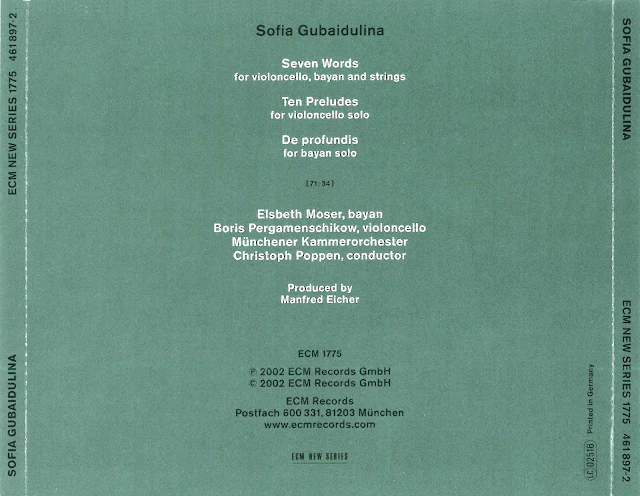
SOFIA GUBAIDULINA : Seven Words • Ten Preludes • De profundis (Elsbeth Moser · Münchener Kammerorchester · Christoph Poppen) (2002) FLAC (image+.cue), lossless
Shostakovich once famously said of his student, Sofia Gubaidulina, “I want you to continue along your mistaken path.” Mistaken, that was, in the former Soviet Union, where the deliverance preached through her devout composing sat uncomfortably with censors. So much so that when she composed her Seven Words in 1982, she was obliged to leave out “…of Our Savior on the Cross” from its title. Nevertheless, this riveting work is one of the twentieth century’s reigning masterpieces. One will want to compare Gubaidulina’s instinctive metaphorical approach to Haydn’s more direct setting of the same. The two could hardly be more different, either in sound or in circumstance, but they clearly embrace the same fragile heart. Providing the blood herein is the bayan, a button accordion typically heard in Russian folk contexts. Through Gubaidulina’s notecraft, and in the hands of longtime associate Elsbeth Moser, it becomes a speech act in its own right. In constant dialogue with a cello soloist and tentative orchestral commentary, the bayan comports itself not unlike the turbulent waves on the album’s sleeve. And while there are far too many moments to single out for praise, the epiphany of Part VI (“It is finished”) is a wondrous experience indeed, and leads us to an ending that is beyond earthly.
The following Ten Preludes (1974, rev. 1999) for cello were originally conceived as instructional etudes, with the final piece leaving room for improvisation, and therefore the creative edge of the performer. Inevitably, these have taken on lives of their own, and flow here in a line of fractured counterpoint that “resets” us for the heavenly strains of De profundis (1978) for bayan alone. The instrument’s multilayered sound lends itself beautifully to the Trinitarian gaze in which it finds itself illuminated, lapsing into trundled passages where lateral divisions turn our souls to the indecipherable limits of their own awareness.
There is no ground on which to stand in this music. One must remain elevated, if not airborne, in relation to one’s expectations, always approaching them from above. It is a revelation to finally have Gubaidulina’s music represented on ECM, where spacious production values give it all the berth it needs. Let us hope this is not a one-off affair. web
Tracklist :
The Seven Last Words, for cello, bayan & strings
Preludes (10) for cello
Musicians
Elsbeth Moser - bayan
Boris Pergamentschikow - cello
Münchener Kammerorchester
Christoph Poppen - conductor
Recorded January 2001, Himmelfahrtskirche Sendling, München
Produced by Manfred Eicher
SOFIA GUBAIDULINA : Canticle of the Sun (Gidon Kremer · Kremerata Baltica) (2012) FLAC (tracks+.cue), lossless
Sofia Gubaidulina doesn't designate either of the pieces on this
recording as concertos even though they feature a solo and ensemble, and
that logic is evident in the sound of the music itself, which
integrates the soloists organically into its texture and structure.
Gubaidulina is unquestionably a modernist and employs a wide spectrum of
contemporary techniques, but she is also a mystic, so her music tends
to convey a striving for transcendence that's expressed in luminous
warmth. She wrote The Lyre of Orpheus for violin, percussion, and string
orchestra for Gidon Kremer and Kremerata Baltica, who deliver a
radiant, shimmering performance. In her notes on the piece, Gubaidulina
deals only with her somewhat arcane strategies for deriving pitches and
chords, but the music itself glows with timbral ingenuity and sweetness,
and almost inevitably invites the listener to call to mind the
poignancy of the myth of Orpheus. She does not mention it in the notes,
but she wrote the piece as a memorial to her daughter, which certainly
accounts for the music's intense depth of feeling. The Canticle of the
Sun for cello, chamber choir, percussion, and celesta was dedicated to
Mstislav Rostropovich, who gave its premiere in 1998. The unique
orchestration gives it an atmosphere of luminous, ethereal mystery. She
wanted to pay tribute to the cellist's famously sunny disposition, and
it has sections that make one of her most exuberant works; the cello
sends major chords rocketing through the first movement and there is a
furiously powerful roar of ecstasy at the end of the second movement.
The piece ends in the major, in an exquisitely delicate filigree of
interwoven lines. Nicolas Altstaedt gives a distinguished, deeply
committed performance, and the Riga Chamber Choir "Kamer…" sings with
lustrous tone. ECM's sound is perfectly clean, realistic, and
beautifully balanced. Stephen Eddins
Tracklist :
1 The Lyre of Orpheus 23:41
Sofia Gubaidulina
Orchestra – Kremerata Baltica
Violin – Gidon Kremer
Violoncello – Marta Sudraba
The Canticle of the Sun
Celesta – Rostislav Krimer
Choir – Riga Chamber Choir "Kamēr..."
Conductor – Māris Sirmais
Lyrics By – St. Francis Of Assisi
Percussion – Andrei Pushkarev
Violoncello – Nicolas Altstaedt
Vocal Percussion – Rihards Zaļupe
2 Glorification of the Creator, and His Creations: the Sun and the Moon 10:13
Sofia Gubaidulina
3 Glorification of the Creator, the Maker of the Four Elements: Air, Water, Fire and Earth 13:20
Sofia Gubaidulina
4 Glorification of Life 14:29
Sofia Gubaidulina
5 Glorification of Death 7:23
Sofia Gubaidulina
SOFIA GUBAIDULINA : Orchestral Music – Pro Et Contra · Märchenbild · Concordanza (Johannes Kalitzke · Radio-Philharmonie Hannover Des NDR · Bernhard Klee) (1994) FLAC (image+.cue), lossless
“… Performances throughout are of the highest calibre, and the recording is as clear as a bell.” Ivan Moody
Tracklist & Credits 


