Mostrando postagens com marcador Peter Hammill. Mostrar todas as postagens

terça-feira, 22 de setembro de 2020

VAN DER GRAAF GENERATOR - The Aerosol Grey Machine (1969-1997) FLAC (image+.cue), lossless

Beginning as a Peter Hammill solo effort following the dissolution of the first Van Der Graaf Generator, this quickly recorded album brought Hammill together with producer John Anthony and caused the reformation of the band (which immediately thereafter shifted personnel once again). A raw, energetic effort that sometimes did little to show off the young Hammill's talents, the album nevertheless has some fine moments that hint at the possibilities for future releases. The fact remains, mind you, that the second album, The Least We Can Do Is Wave to Each Other, is far superior. [CD versions of this album appeared in 1996 and 1997, both including additional material such as the first (and very rare) Van Der Graaf Generator single, and the previously unreleased VDGG recording of "Ferret and Featherbird."] by Steven McDonald

Tracklist:
1 Afterwards 4:58
2 Orthenthian St 6:19
3 Running Back 6:36
4 Into A Game 6:57
5 Ferret & Featherbird 4:34
6 Aerosol Grey Machine 0:46
7 Black Smoke Yen 1:27
8 Aquarian 8:21
9 Giant Squid 3:19
- Bonus Tracks -
10 Octopus 7:57
11 Necromancer 3:30
Credits:
Bass, Backing Vocals – Keith Ellis
Drums, Percussion – Guy Evans
Flute – Jeff Peach
Piano, Organ, Percussion, Backing Vocals – Hugh Banton
Vocals, Acoustic Guitar – Peter Hammill
Written-By – Guy Evans (tracks: 4, 7, 9), Hugh Banton (tracks: 4, 7, 9), Keith Ellis (tracks: 4, 7, 9), Peter Hammill (tracks: 1 to 6, 8 to 11)

VAN DER GRAAF GENERATOR - The Least We Can Do Is Wave to Each Other (1970-2005) RM / SHM-CD / FLAC (image+.cue), lossless

Peter Hammill has always had an abiding interest, it seems, in the blurred boundary between the mystical and the scientific, and between the rational and magical mind; this is certainly evident on the debut Van Der Graaf Generator album, even though Hammill had yet to really begin focusing himself on what it was that was driving him (despite the fact that the band's very name referenced a device that resembles a bastard mix of scientific apparatus and shamanic totem). The Least We Can Do brings those concerns to the fore with ferocity, with time out for a couple of more personal pieces ("Refugees" and "Out of Our Book"). Hammill's lyrics, delivered with all the passion and intent he can muster, reference mysticism, numerology, astrology, various religious pantheons, the Malleus Maleficarum (leading Hammill to conclude, a bit too hopefully, that magic needs to be gray to be balanced), Robert van deGraaf himself (in "Whatever Would Robert Have Said?"), the future of humanity, and surviving ecological catastrophe. This being the start of the 1970s, the hopeful notes are drowned out by the tidal wave of fear, sadness, and despair, despite which, the music does tend to be rather uplifting, thanks to the undercurrent of barely restrained majesty VDGG tended to have (possibly thanks to Hugh Banton, who had been rather used to communicating with God via church and cathedral organs; he brought that expertise to a position more normally occupied by determined B3 thumpers engaged in battle with show-horse guitarists). The main thing that The Least We Can Do is in need of now is a good remastering job (and the addition of a few leftover tracks, such as the "Refugees" single version and its B-side.) [The Virgin CD transfer is a lazy example of taking an album master and making a CD master from it, leaving the album lacking dynamic range and sounding a bit muffled.] by Steven McDonald   

Tracklist
:
1 Darkness (11/11) 7:28
2 Refugees 6:22
Cello – Mike Hurwitz
Piano – Peter
Written-By [Cello Parts] – Hugh

3 White Hammer 8:18
Cornet – Gerry Salisbury
4 Whatever Would Robert Have Said? 6:07
5 Out Of My Book 4:08
Written-By – Jackson, Hammill
6 After The Flood 11:37
- Bonus Tracks - 
7 Boat Of Million Of Years 3:55
8 Refugees (Single Version) 5:27
Credits:
Acoustic Guitar, Lead Vocals – Peter Hammill
Bass, Electric Guitar – Nic Potter
Drums, Percussion – Guy Evans
Organ, Piano, Backing Vocals – Hugh Banton
Remastered By – Peter Hammill
Tenor Saxophone, Alto Saxophone, Flute, Backing Vocals – David Jackson
Written-By – Peter Hammill (tracks: 1 to 4, 6 to 8)

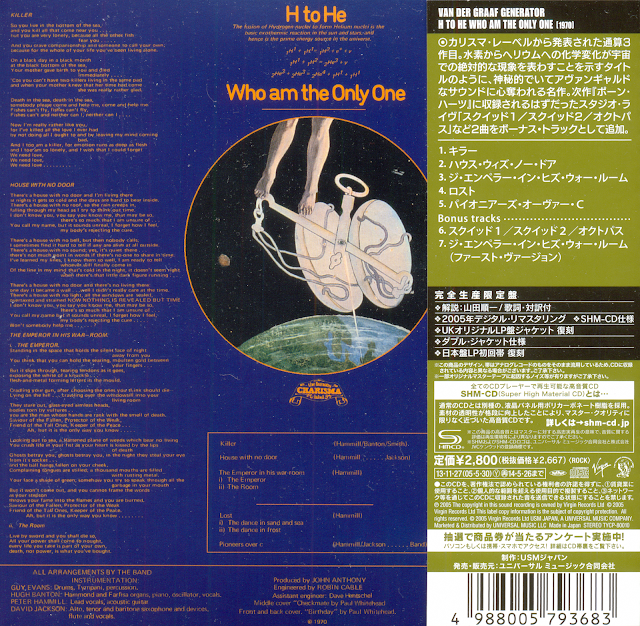
VAN DER GRAAF GENERATOR - H to He Who Am the Only One (1970-2005) RM / SHM-CD / FLAC (image+.cue), lossless

The foreboding crawl of the Hammond organ is what made Van Der Graaf Generator one of the darkest and most engrossing of all the early progressive bands. On H to He Who Am the Only One, the brooding tones of synthesizer and oscillator along with Peter Hammil's distinct and overly ominous voice make it one of this British band's best efforts. Kicking off with the prog classic "Killer," an eight minute synthesized feast of menacing tones and threatening lyrics, the album slowly becomes shadowed with Van Der Graaf's sinister instrumental moodiness. With superb percussion work via Guy Evans, who utilizes the tympani drum to its full extent, tracks like "The Emperor in His War-Room" and "Lost" are embraced with a blackened texture that never fades. The effective use of saxophone (both alto and tenor) and baritone from David Jackson gives the somberness some life without taking away any of the instrumental petulance. H to He is carpeted with a science fiction theme, bolstered by the bleak but extremely compelling use of heavy tones and the absence of rhythms and flighty pulsations. This album, which represents Van Der Graaf in their most illustrious stage, is a pristine example of how dark progressive rock should sound. by Mike DeGagne 

Tracklist
:
1 Killer 8:25
2 House With No Door 6:38
3 The Emperor In His War Room 8:19
4 Lost 11:18
5 Pioneers Over C 12:52
- Bonus Tracks -
6 Squid 1 / Squid 2 / Octopus 15:24
7 The Emperor In His War Room (First Version) 8:51
Credits:
Drums, Percussion, Timpani – Guy Evans
Lead Vocals, Acoustic Guitar – Peter Hammill
Organ, Piano, Vocals – Hugh Banton
Saxophone, Flute, Vocals – David Jackson

segunda-feira, 21 de setembro de 2020

VAN DER GRAAF GENERATOR - Pawn Hearts (1971-2005) RM / SHM-CD / FLAC (image+.cue), lossless

Van Der Graaf Generator’s third album, Pawn Hearts was also its second most popular; at one time this record was a major King Crimson cult item due to the presence of Robert Fripp on guitar, but Pawn Hearts has more to offer than that. The opening track, “Lemmings,” calls to mind early Gentle Giant, with its eerie vocal passages (including harmonies) set up against extended sax, keyboard, and guitar-driven instrumental passages, and also with its weird keyboard and percussion interlude, though this band is also much more contemporary in its focus than Gentle Giant. Peter Hammill vocalizes in a more traditional way on “Man-Erg,” against shimmering organ swells and Guy Evans’ very expressive drumming, before the song goes off on a tangent by way of David Jackson’s saxes and some really weird time signatures — plus some very pretty acoustic and electric guitar work by Hammill himself and Fripp. The monumental “Plague of Lighthouse Keepers,” taking up an entire side of the LP, shows the same kind of innovation that characterized Crimson’s first two albums, but without the discipline and restraint needed to make the music manageable. The punning titles of the individual sections of this piece (which may have been done for the same reason that Crimson gave those little subtitles to its early extended tracks, to protect the full royalties for the composer) only add to the confusion. As for the piece itself, it features enough virtuoso posturing by everyone (especially drummer Guy Evans) to fill an Emerson, Lake & Palmer album of the same era, with a little more subtlety and some time wasted between the interludes. The 23-minute conceptual work could easily have been trimmed to, say, 18 or 19 minutes without any major sacrifices, which doesn’t mean that what’s here is bad, just not as concise as it might’ve been. But the almost operatic intensity of the singing and the overall performance also carries you past the stretches that don’t absolutely need to be here. The band was trying for something midway between King Crimson and Genesis, and came out closer to the former, at least instrumentally. Hammill’s vocals are impassioned and involving, almost like an acting performance, similar to Peter Gabriel’s singing with Genesis, but the lack of any obviously cohesive ideas in the lyrics makes this more obscure and obtuse than any Genesis release. by Bruce Eder   

Tracklist:
1. Lemmings (including Cog)
2. Man-erg
3. A Plague Of Lighthouse Keepers
- Bonus Tracks - 
4. Theme One (Original Mix)
5. W (First Version)
6. Angle Of Incidents
7. Ponker’s Theme
8. Diminutions
Personnel:
Peter Hammill – lead vocals, acoustic and slide guitar, electric piano, piano
Hugh Banton – Hammond and Farfisa organs, piano, mellotron, ARP synthesizer, bass pedals, bass guitar, backing vocals
Guy Evans – drums, tympani, percussion, piano
David Jackson – alto, tenor, and soprano saxophones, flute, and backing vocals
Additional personnel:
Robert Fripp – electric guitar ("Man-Erg" and "A Plague of Lighthouse Keepers" and near the end of the song)

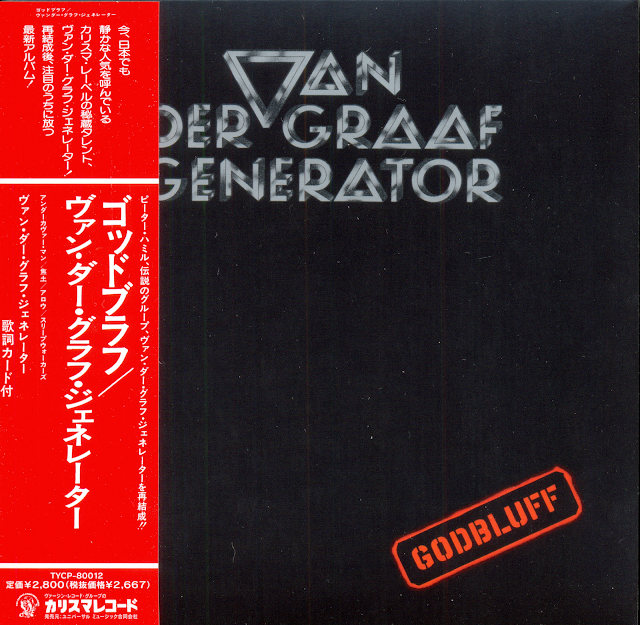
VAN DER GRAAF GENERATOR - Godbluff (1975-2005) RM / SHM-CD / FLAC (image+.cue), lossless

Following the release of Pawn Hearts, bandleader Peter Hammill took time out to develop a solo career, choosing to focus his energy on darkly introspective works that seemed to be intended to examine the personal consequences of his life. When it came time for reuniting the members of Van Der Graaf, this change in direction had its effect on the band's post-1975 music. While the musical structures continued to be complex and dense, there seemed to be far less accent on the demonstration of musical skill than had formerly been the case. Indeed, the album opened with daring quietness, with David Jackson's flute echoing across the stereo space, joined by Hammill's voice as he whispered the opening lines. There was sturm und drang to come, but the music had been opened up and the lyrics had developed more focus, often abandoning metaphor in favor of statement. Godbluff was a bravura comeback -- only four cuts, but all were classics. by Steven McDonald
 

Tracklist:
1 The Undercover Man 7:32
2 Scorched Earth 9:38
3 Arrow 9:45
4 The Sleepwalkers 10:31
Bonus 
5 Forsaken Gardens 7:54
6 A Louse Is Not A Home 12:48

Credits:
Drums, Percussion – Guy Evans
Guitar, Piano, Vocals, Remastered By – Peter Hammill
Organ, Bass – Hugh Banton
Saxophone, Flute – David Jackson
Written-By – David Jackson (tracks: 2), Peter Hammill


VAN DER GRAAF GENERATOR - World Record (1976-2005) RM / SHM-CD / FLAC (image+.cue), lossless

Released in the latter half of 1976 as a half-hearted attempt at some sort of commercial focus in the U.K. and U.S., World Record suffers from several ailments: there was much tension in the band at this point, particularly between leader Peter Hammill and keyboardist Hugh Banton. In the end, the band would split apart, with Banton and wind player David Jackson leaving, while Hammill and drummer Guy Evans recruited replacements. World Record is very much a divided record, sounding beautifully clean, but lacking in both performance and focus. Evans plays as well as ever, but without the creative spark of earlier records; Hammill, meanwhile, was responsible for the rambling, scattered "Meurglys III (The Songwriter's Guild)," a lumbering piece named after one of his guitars. Of the cuts present, the best are the operatic "Masks," which mines one of Hammill's favorite themes, that of identity, and "Wondering," written in collaboration with Banton. "Wondering" is beautifully hymn-like until the very end, when it suddenly becomes querulous and uncertain, ending the album both with a note of hope and a desperate question. by Steven McDonald 
 

Tracklist:
1 When She Comes 8:04
2 A Place To Survive 10:05
3 Masks 7:02
4 Meurglys III (The Songwriter's Guild) 20:50
5 Wondering (Written-By – Hugh Banton, Peter Hammill) 6:43

- Bonus Tracks -
6 When She Comes 8:14
7 Masks 7:25
Credits:

Bass [Manuals And Pedals (manuel And His Music Of The Pedallos)] – Hugh Banton
Drums, Percussion, Cymbal, Other [Fingerpop] – Guy Evans
Saxophone [Alto, Tenor, Soprano, Accoutrements], Flute [All In The Grotto] – David Jackson
Vocals [Vox], Guitar [Meurglys Iii And Wassistderpunktenbacker], Lyrics
, Written By – Peter Hammill


VAN DER GRAAF GENERATOR - Still Life (1976-2005) RM / SHM-CD / FLAC (image+.cue), lossless

VDGG's second step on the mid-'70s comeback trail saw Peter Hammill attempting to meld the introspective and the cosmic throughout, though this did not stop him from taking a dead run at a grandiose concept or two -- the consequences of immortality on the title track, and the grand fate of humanity on the epic "Childlike Faith in Childhood's End." The theme of humane cooperation informs the opening "Pilgrims," while "La Rossa" is an epic tale of desire fulfilled (a story that would be concluded on Hammill's solo album, Over). The true highlight, however, is the beautiful, pensive "My Room (Waiting for Wonderland)," with its echoes of imagination and loss. Hammill did not achieve such a level of painful beauty again until "This Side of the Looking Glass" on Over.  by Steven McDonald
 

Tracklist:
1 Pilgrims 7:11
2 Still Life 7:24
3 La Rossa 9:52
4 My Room (Waiting For Wonderland) 8:03

5 Childlike Faith In Childhood's End 12:38
- Bonus Track -
6 Gog 10:29
Credits:
Written-By – David Jackson (tracks: 1), Peter Hammill
Drums, Percussion – Guy Evans
Organ, Pedalboard [Bass Pedals], Mellotron, Piano – Hugh Banton
Saxophone, Flute – David Jackson
Vocals, Guitar, Piano – Peter Hammill