 The solo debut of instrumental fusion rock from the former guitarist with The Dregs/Dixie Dregs, Introduction features an excellent mix of styles and top-notch playing. Guitarist Albert Lee guests on this effort. Highlights include the hyperdrive "Cruise Missile," "General Lee," and the anthemic title track. Paul Kohler
Tracklist + Credits :
Mostrando postagens com marcador Steve Morse. Mostrar todas as postagens
Mostrando postagens com marcador Steve Morse. Mostrar todas as postagens
quarta-feira, 24 de maio de 2023
STEVE MORSE BAND – The Introduction (1984) FLAC (tracks+.cue), lossless

STEVE MORSE BAND – Stand Up (1985-2002) FLAC (tracks+.cue), lossless
 A rock/jazz/country blend and an excellent mix of instrumental and vocal material, it includes a cameo by guitarist Eric Johnson and guest vocalists. Paul Kohler
Tracklist + Credits :
STEVE MORSE – High Tension Wires (1989) FLAC (tracks+.cue), lossless

The AllMusic staffer that wrote the review is mistaken - it isn't debatable if this record is jazz, because it is decidedly NOT jazz. However, that shouldn't lower the review below 4 stars, because taken as it is, this is a stunning tour-de-force of Morse's guitar playing, composition, and arranging, not to mention great bass playing & drumming as well as clear, direct production. Morse reportedly composed these tunes to counter the criticism that he only knew how to shred, and the beauty & subtlety of most of the compositions show his versatility, but "Tumeni Notes," as well as moments in Highland Wedding, and others show he can shred with the best of them. Highly recommended if you like intellectual (progressive) guitar rock, especially if you're feeling more mellow than usual. Kyle Kivett
Tracklist + Credits :
terça-feira, 23 de maio de 2023
STEVE MORSE – Major Impacts (1991) FLAC (tracks+.cue), lossless
 Occasional Dixie Dregs frontman and solo fret shredder Steve Morse tackles a fascinating project here as he plays each of these 11 instrumental tunes in the style of a different guitarist and/or band who was influential on his own technique. From obvious six-string heroes Clapton, Page, Hendrix, and Jeff Beck to more obscure ones like Mountain's Leslie West, Mahavishnu Orchestra's John McLaughlin, the Byrds' Roger McGuinn, with stops at George Harrison, Duane Allman, and Keith Richards, Morse grabs onto riffs, song passages, tones, and direct guitar quotes from these stars then inserts them into original tunes written expressly for this undertaking. Not surprisingly some work better than others. The chunky "Start Me Up" approach of "How Does It Feel" sounds as if the new song was simply rewritten with a few of Richards' trademarked chords. "Led On," Morse's Jimmy Page tribute where he attempts to stuff as much of Page's Indian, blues, and crunch stylized techniques as can be shoehorned into one song, results in a choppy, unfocused, and over-busy jumble. Morse obviously put substantial work, time, and research into this project, and the multiple overdubs, as well as the uncanny way he imitates his idols (the Leslie West tribute "Bring It to Me" is startling in its similarity to the Mountain man's husky style) will have the listener often wondering what album they put on. On the down side, these songs don't successfully stand on their own merits. They sound like they were cut and pasted onto the shell of the guitarists Morse loves, without the melodic structure to qualify as successful tunes in their own right. It's more than simply stringing riffs together, yet nothing here resonates with the impact of the guitarists Morse admires. Still, this is an often captivating and consistently diverse album, and one that guitar students in particular will savor and play repeatedly. But not as much as the discs of the artists from which Steve Morse nicks his licks. Hal Horowitz
Tracklist + Credits :
STEVE MORSE – Major Impacts 2 (2004) FLAC (tracks), lossless
 Major Impacts was an interesting idea pitched to Steve Morse: paying tribute to the myriad of bands, players, and musical styles that have influenced him not by doing covers, but by recycling the riffs and feel of those influences and crafting Morse originals out of them. No surprise, Major Impacts, Vol. 2 is more of the same, though with some choices that may surprise people. "Wooden Music" does a great job of evoking Crosby, Stills, Nash & Young with nice acoustic playing and harmonized guitars. His tribute to the music of the British Invasion starts with a Hollies 12-string intro and ends up somewhere near "Itchycoo Park," and "Where Are You" is a well put together tip to the Who, where drummer Van Romaine does a good Keith Moon. "Organically Grown" supplies the bombast of ELP and "Abracadabra" has the quirky construction of post-Peter Gabriel Genesis. The somewhat surprising choices are the Bach-esque piece "Air on a 6 String" and the country-western/bluegrass hoedown "Tri County Barn Dance." Morse's salute to Enya and the Celtic ballad is right on target: superficially pretty yet ultimately bland, and the only real misstep on the album. Major Impacts, Vol. 2 really shows what a versatile player Morse is, and why he's been a member of bands as disparate as the Dixie Dregs, Kansas, and Deep Purple. Sean Westergaard
Tracklist + Credits :
segunda-feira, 22 de maio de 2023
STEVE MORSE BAND – Southern Steel (1991) FLAC (tracks), lossless
 Morse always delivers, especially on this uptempo, hard-hitting, instrumental rock virtuosity. Paul Kohler
Tracklist + Credits :
STEVE MORSE BAND – Coast to Coast (1992) FLAC (tracks), lossless
 Right from the opening of Coast to Coast, where Steve Morse's inimitable guitar threatens to overwhelm the listener with flat-picked arpeggios, the ex-Dixie Dregs guitarist/composer is all over this trio album. From classical guitar to guitar synth, this is a record made by one of the greats using all of the tools in his sizeable vocabulary to express his muse. All of the ten songs on this record are short, with only one clocking in at over four minutes, but Morse has packed a lot into each of them. They are multi-layered, with many different themes and melodies, each building to a logical conclusion. One of Morse's greatest gifts, among being a guitar genius and brilliant composer, is that of a peculiarly skilled arranger. Each of his songs tells a story, and this ability is even more well-honed here than with his heyday with the Dixie Dregs in the late '70s. As expected from Morse, his songs exhibit a wide variety of musical influences. Always a pleasure on Morse's albums are his country numbers, and the offering on Coast to Coast, the aptly named "Runaway Train," is no exception to this rule. Dave LaRue's slap bass is a bit of an acquired taste on this track, but it serves to tie the song to the larger picture of the band's sound, and as such is permissible. Not as essential as his work with the Dixie Dregs, but a fine offering from a talented and overlooked musician and songwriter. Daniel Gioffre
Tracklist + Credits :
STEVE MORSE BAND – Structural Damage (1995) FLAC (tracks), lossless
 Another great Steve Morse Band release! The SMB catalog is interesting because except for "Stand Up" with the cheesy vocal numbers all of the albums are almost interchangeably similar... but interchangeably excellent in composition, style, tone and playing. This album is no exception: Just an album of instrumental fire, perfectly played and executed. If you like the rest of his stuff, you will like this just as much!. Nikki Lev
Tracklist + Credits :
STEVE MORSE BAND – Split Decision (2002) FLAC (tracks+.cue), lossless
 In a world where many brilliant guitarists keep trying to smooth out to get more airplay, it's reassuring to know that there's still room for wild, jamming, and magnificently noisy projects whose tough-minded edges guitar students can drool over. The Dixie Dregs founder who has won "Best Overall Guitarist" by Guitar Player's reader's poll five times -- and has received six Grammy nominations -- does an unabashedly energetic turn here with his buddies Dave LaRue (bass) and Van Romaine (drums). There's a bit of the Dregs in the spirit of the opening heavy "Heightened Awareness," beginning with the crunchy rock guitar climbing over a throbbing bassline; Morse then expands the distortion before reining in and creating a challenging duality with LaRue. Morse is a big Bach fan, and he uses the classical composer's Brandenburg Concerto as a springboard of inspiration for the innovative ideas behind the brief but sizzling "Busybodies." "Marching Orders" once again counterpoints the guitar and bass in unique fashion, and adds to its improvisations some crunching chords that recall some of the '80s best corporate rock. "Mechanical Frenzy" offers up a little of the Led Zeppelin vibe, mixing roaring passages with speedy melodic lines that end in potent exclamation marks of big drum fills and crazy distortion. For those with delicate ears, there's a pretty melody easily discerned behind the monster Wall of Sound on "Great Mountain Spirits." Morse relaxes to the point of smooth jazziness on "Moment's Comfort" and "Clear Memories," which show that he's also interested in lush melodies (even acoustic-oriented ones) in addition to just going nuts all the time. The flow of the disc moves from hardcore shedding to a cooler prevailing spirit by the end. Jonathan Widran
Tracklist + Credits :
STEVE MORSE BAND – Out Standing in Their Field (2009) FLAC (tracks+.cue), lossless
 Although Steve Vai and Joe Satriani get the lion's share of the credit for popularizing "instrumental guitar-driven rock" for metalheads in the late '80s, another gentleman was merrily shredding on the six-string around this same era (and issuing all-instrumental recordings, as well) -- Steve Morse. And despite a full-time gig as Ritchie Blackmore's replacement in Deep Purple since 1994, Morse has managed to find the time along the way to reunite with his trusty rhythm section of bassist Dave LaRue and drummer Van Romaine, and issue albums credited solely to the Steve Morse Band. Case in point, the trio's 2009 offering, Out Standing in Their Field. Times and tastes may change in the rock world on a seemingly moment to moment basis, but you always know what's in store with a new Morse Band release -- tunes that include unmistakable Zeppelin-esque grooves ("Name Dropping"), mellow detours ("Here and Now and Then"), and of course, chicken-pickin' country ditties ("John Deere Letter"). As far as technique goes, Morse can shred and pluck with the most dexterous of six-string slingers -- further proven with the arrival of Out Standing in Their Field. Greg Prato
Tracklist + Credits :
sexta-feira, 19 de maio de 2023
DIXIE DREGS – Free Fall (1977-1998) RM | FLAC (tracks+.cue), lossless
 The debut recording from the Dixie Dregs (The Great Spectacular is considered a demo) stands as one fusion's high-water marks. This music is wholly original and played with a freshness and vigor that had begun to wane in a genre that was becoming a model in self-parody. The influences here are plentiful, but it is the country roots that provide the music with its vitality. Founder/guitarist Steve Morse proved to be an important new guitarist, offering an inimitable style with the technique the music demands. The music is complex and challenging, but that's easy to overlook due to the band's sunny approach. While they would go on to create more fully realized recordings, this one proved that fusion had a soul. Robert Taylor
Tracklist + Credits :
quinta-feira, 18 de maio de 2023
DIXIE DREGS – What If (1978-1990) RM | FLAC (tracks+.cue), lossless
 Calling the Dixie Dregs a fusion band doesn't really do them justice. Granted, their music is full of the complicated forms, jazz-influenced improvisations, and heavy rock attitude of the genre, but the Dregs also incorporate country, folk, and classical elements into their compositions. Although there is more than a little of the 1970s fusion of Jeff Beck and the Mahavishnu Orchestra in their music and especially on this record, the Dixie Dregs transcend these genre limitations so well that they might as well be performing in a different idiom. On What If, their finest album, Steve Morse and company breathtakingly illustrate their peculiar musical vision. As per standard operating procedure, Morse is the primary composer and chief sonic architect. He is blessed with some of the greatest technique in rock guitar, and he utilizes every facet of it, whether burning unison runs with violinist Allen Sloan, chunking heavy, palm-muted lines along with bassist Andy West, or playing impressively contrapuntal classically inflected nylon-string guitar. Morse also has a very distinctive composing voice, and this shines through on seven of the eight tracks. The strongest moments on What If are Morse songs that incorporate a more folky influence into the fusion, such as the almost straight-up country of "Gina Lola Breakdown." Also impressive is West's lone songwriting contribution, "Travel Tunes." This song lives up to its name by moving between melodies apparently derived from British folk music, angular fusion grooves, a Caribbean-sounding interlude, and straight-up rock & roll. The fact that the Dixie Dregs do this is a credit to their creativity; the fact that it works is a testament to their musicianship. This is music without labels -- emotional and logical at the same time, passionately played, and immaculately conceived. It is worth every penny. Daniel Gioffre
Tracklist + Credits :
quarta-feira, 17 de maio de 2023
DIXIE DREGS – Night of the Living Dregs (1979-1991) RM | FLAC (tracks+.cue), lossless
 In the 1970s, when fiery-fingered exercises in jazz-rock fusion were all the rage in both the United States and the U.K., the Dixie Dregs brought a Southern slant to the style, injecting a touch of twang into the proceedings. NIGHT OF THE LIVING DREGS (1979) catches the band at a key transitional point. While essentially a studio album, some tracks are from a 1978 concert featuring new keyboard player T. Lavitz, whose synthesizer work would become an important part of the band's sound. Throughout the album, Steve Morse's fiery guitar, Allen Sloan's Jean-Luc-Ponty-on-Wild-Turkey violin, and Andy West's frenetic, popping bass all play demolition derby amid metrically and harmonically sophisticated compositions that still offer plenty of visceral satisfaction. AllMusic
Tracklist + Credits :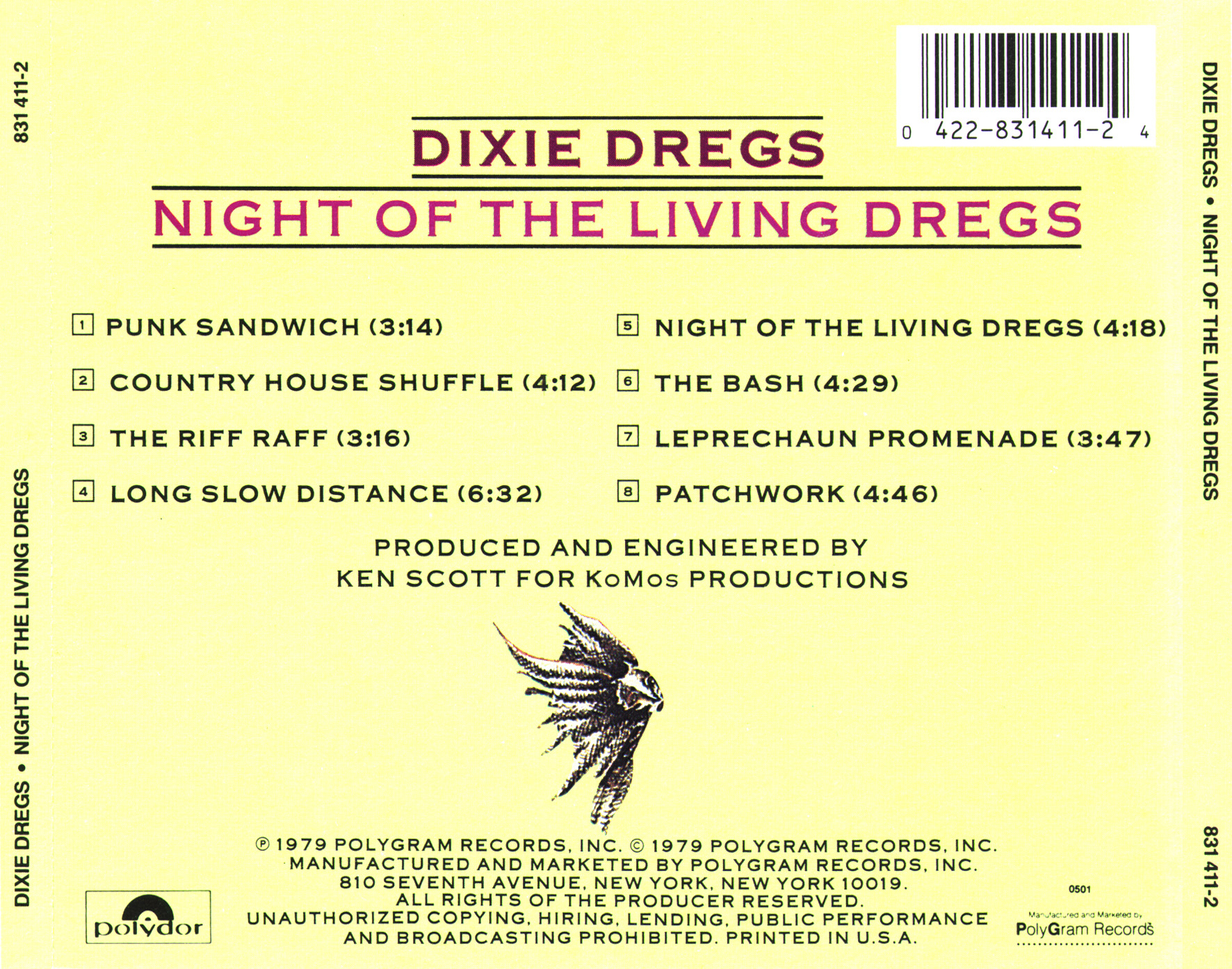
domingo, 14 de maio de 2023
THE DREGS – Industry Standard (1982-1992) FLAC (tracks+.cue), lossless
 Although they dropped the "Dixie" from their name in 1981, Industry Standard is still basically what one would expect from the Dixie Dregs. It also proved to be the band's last album before they disbanded, with fans having to wait ten years for a reunion and a new record. This incarnation of the band is actually the strongest one musician-wise, with master fiddler Mark O'Connor (in his lone appearance as a Dreg) making strong solo and ensemble statements. O'Connor really gets to show off his stuff on the requisite country-tinged instrumental, in this case the amusingly titled "Where's Dixie?" By this point, Steve Morse's compositional acumen had reached the level of complexity and polyphony that he would mine in his solo work throughout the '80s and '90s, and the sound of the band is more streamlined than ever before. Gone from Industry Standard are many of the Mahavishnu-isms that were so present in the band's work from the 1970s. One peculiar feature of this record is the presence of two vocalists, ex-Santana member Alex Ligertwood, and Doobie Brother Patrick Simmons, on one track each. This marks the first and only time the Dregs incorporated singing into their music. The album suffers somewhat from its inclusion, although there are some fine moments in the Steely Dan-inspired "Ridin' High." The excellent "Chips Ahoy" is perhaps the strongest track on Industry Standard, with a lilting, haunting melody played, paradoxically, at breakneck speed by Morse and O'Connor. Also of note is the driving "Assembly Line" and a lovely acoustic guitar duet, "Up in the Air," between Morse and Yes' Steve Howe. Morse, as per standard operating procedure, demonstrates his versatility, range, and chops throughout the album. The interplay between the guitarist and drummer Rod Morgenstein is particularly stunning, as in Morse's cathartic solo in "Conversation Piece." All in all, Industry Standard is one of the band's strongest albums, although it plays more like a Steve Morse solo record than any other Dregs release. To those not bothered by this, it will undoubtedly provide hours of listening enjoyment. [Long out of print, Industry Standard was re-released in 1992 by BMG, and is available as a Japanese import.] Daniel Gioffre
Tracklist + Credits :


Assinar:
Postagens (Atom)